
Links: Navigator Page | Chemical Index | State Index | Operator Index
 Open-FF |
194041-65-1 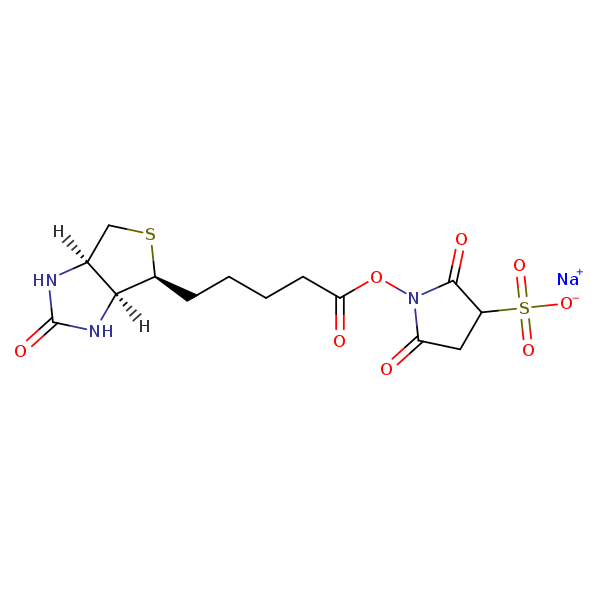 This file was generated on April 21, 2025 |
 Sponsored by FracTracker Alliance |
Open-FF Chemical Report
This is a script-generated report about a specific chemical used in the Hydraulic Fracking industry. The source of these data is the industry-sponsored website FracFocus, but are analyzed by the independent project Open-FF.
Molecule images courtesy of CompTox. Disclosures before 2011 are not included.
Table of Contents
- General information about the chemical
- General usage within FracFocus & where those records occur
- Detailed usage for all records
- Uses by percentage of the fracking fluid
- Uses by mass
- Companies supplying and using this chemical
- Patterns of use
- Disclosures list of biggest 100 uses with map links
- Tables of raw Names, CAS Numbers and Trade names associated with this chemical
Names for "194041-65-1":
| Source | Name |
|---|---|
| SciFinder primary name: | 1H-Thieno[3,4-d]imidazole-4-pentanoic acid, hexahydro-2-oxo-, 2,5-dioxo-3-sulfo-1-pyrrolidinyl ester, sodium salt (1:1), (3aS,4S,6aR)- |
| EPA - preferred name: | Sodium 2,5-dioxo-1-({5-[(3aS,4S,6aR)-2-oxohexahydro-1H-thieno[3,4-d]imidazol-4-yl]pentanoyl}oxy)pyrrolidine-3-sulfonate |
| IUPAC name: | ** ** |
| Most frequently used name in FF: | d-biotin ,usp |
See table of raw names for other names used for this material
Summary from EPA's ChemInformatics
For more detailed information, see the ChemInformatics web site
No ChemInformatics analysis available
Important: Please do NOT infer that the absence of an EPA analysis here implies this chemical is not hazardous. Many fracking materials are not quantified for toxicity because they are still poorly studied or are a mix of unknown or variable composition (even though the constituents are likely to be toxic).
Elsner and Hoelzer Structural Groupings
We adopt a classification scheme based on the work of Elsner and Hoelzer (2016), which organizes chemicals primarily by their core molecular structure and key functional groups, organizing by large classes such as Alcohols and Inorganic Chemicals. Within most of these broad classes, chemicals are further grouped into subgroups sharing more specific structural similarities. See an overview and index of these groups and their details.
For FracFocus materials that were not classified in Elsner and Hoelzer (2016), we used a chatGPT reasoning model to assign an appropriate Elsner and Hoelzer classification. If that was necessary, the model's justification for its classification is given below.
Level 1: Organosulfonates and -sulfates --- Level 2: organosulfonates
ChatGPT justification for classifying decision:
**FG** Organosulfonates and -sulfates;organosulfonates

The chemical in question contains a sulfonate group (`3-sulfo-1-pyrrolidinyl ester`) and is present as a sodium salt. These features are characteristic of organosulfonates, which are organic compounds containing sulfonate groups. Given the presence of the sulfonate functionality within the molecular structure, the most appropriate classification falls under **Organosulfonates and -sulfates;organosulfonates**.
General frequency of use
| Unfiltered data set | Filtered data set | with calculated mass | |
|---|---|---|---|
| Num disclosures | 147 | 147 | 103* |
| % of disclosures | 0.078% | 0.0804% | 0.0564% |
*See below for list of companies not reporting enough info for mass calculations
Where this material has been reported
FracFocus records that have conflicting or non-standard location data are not included in this map. This includes many records in Alaska.
Detailed Uses
Each "use" below represents a single record in a disclosure, that is, a single line. A given disclosure may have more than one record of a particular chemical.
Using all filtered data for this chemical.
Uses by percent of the fracking job
This measure roughly shows a comparison of the concentration of the chemical in the whole fracking job (including the base fluid which is typically over 80%). Only the disclosures where the sum of PercentHFJob is within 5% of 100% are considered "valid."

PERCENTILES:
 -- 25%:  1e-07 percent
 -- 50%:  3e-07 percent
 -- 75%:  4e-07 percent
 -- max:  1.1e-06 percent

Uses by mass
This measure shows a comparison of the absolute quantity of a chemical used in a fracking job.

Number of records with a mass (blue circles): 103
Number of records without a calculable mass (orange bars): 44
mass PERCENTILES:
 (represented by lines in the figure)
 -- 25%:  0 pounds
 -- 50%:  0 pounds
 -- 75%:  0 pounds
 -- 95%:  0 pounds
 -- 99%:  0 pounds
 -- max:  0 pounds


Which suppliers are most frequently named for this chemical?
The field reported below is bgSupplier.

Which primarySuppliers are most frequently associated with this chemical?
The primarySupplier is a disclosure-level value and is not necessarily related to a given chemical record. Nevertheless, it indicates the supplier with the most records in a fracking job.

Total mass reported by operator: Who uses the biggest quantity?
The field reported below is bgOperator.

Total mass reported by primarySupplier - biggest associations


Across some of the primarySuppliers

| mass | massSource | APINumber (FF link) | bgStateName | bgCountyName | bgOperatorName | TotalBaseWaterVolume | date | primarySupplier | bgSupplier | TradeName_trunc |
|---|---|---|---|---|---|---|---|---|---|---|
|
Loading ITables v2.2.2 from the init_notebook_mode cell...
(need help?) |
Raw fields for this chemical
These are the fields in the raw FracFocus data as they are entered for the records positively identified as this chemical. These raw fields often have typos, variations on a chemical name, etc. In some cases, two variations may seem identical, but probably differ by non-printing characters.
Shown are operators and how many records without mass, as well as the types of information missing or in error for each company. In addition, not all disclosures are curated by Open-FF yet.
| Operator | records without mass | % carrier not curated | % without TBWV | % no water carrier record | % total percent out of tolerance | % no PercentHFJob | |
|---|---|---|---|---|---|---|---|
|
Loading ITables v2.2.2 from the init_notebook_mode cell...
(need help?) |