Looking for a different chemical? To Chemical Index
7440-24-6: Strontium
Chemical details of Strontium
Chemical Identity
- Preferred Name: Strontium
 CASRN: 7440-24-6
 Substance Class(es) (from SciFinder): Element
- E&H Chemical Class L1: Insoluble inorganic materials ; L2: metals
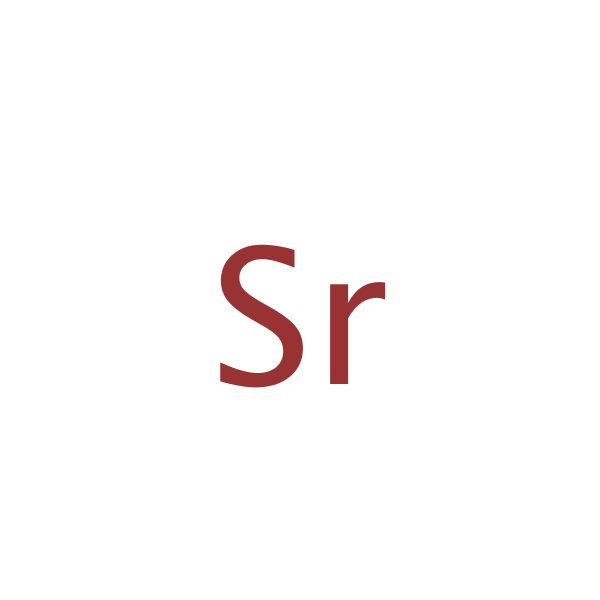
Molecular Structure
HAZARD EVIDENCE
Hazard Tiers
Tier levels(1) Hazard classes(2)
-
Open-FF's Compiled Hazard Summary:
Tier 1: Authoritative GHS record of substantial hazard
Tier 2: Expanded perspective
Tier 3: Demonstrated Low Hazard
Tier 4: Data Deficient
-
Hazard classes:
CMR: Carcinogen, Mutagen or Reproductive hazard
IHL: Inhalation hazards
ORL: Oral hazards
SKN: Dermal and eye hazards
OGN: Organ and systemic hazards
EDC: Endocrine disruption hazards (note that GHS does not yet have comprehensive classification of EDCs. Therefore, the strongest hazard level in this system is effectively level 2)
ENV: Environmental hazards
Our Tier Summary: This chemical exhibits known hazards related to carcinogenicity, mutagenicity, and reproductive toxicity (CMR Tier 1), as well as dermal and eye hazards (SKN Tier 1). However, significant data gaps exist for its environmental, endocrine disruption, inhalation, oral, and organ/systemic hazards, which are all categorized as Data Deficient (Tier 4).
Evidence for Tier levels
(Select category below for more detail)
The overall tier level for Strontium is based on its most severe hazard class(es): - Tier 1
Carcinogenic, Mutagenic, or Reproductive Toxicity - Tier 1
- H360: May damage fertility or the unborn child (PubChem)
- H360D: May damage the unborn child (ChemInformatics)
Endocrine Disruption - Tier 4
- no data found
Environmental Hazard - Tier 4
- no data found
Inhalation Hazard - Tier 4
- no data found
Oral Hazard - Tier 4
- no data found
Dermal/Eye Hazard - Tier 1
- H314: Causes severe skin burns and eye damage (ChemInformatics; PubChem)
- H315: Causes skin irritation (ChemInformatics; PubChem)
- H318: Causes serious eye damage (ChemInformatics; PubChem)
Organ Hazard - Tier 4
- no data found
Lists of Concern and/or Low Hazard
Strontium is listed by the EPA's Drinking Water Standard, indicating it is a chemical of concern regarding drinking water quality. It is not identified on any lists as a low hazard substance.
List of Concerns: Details
EPA's Drinking Water Standard From EPA: "The EPA's Drinking Water Standard and Health Advisories Table summarizes EPA's drinking water regulations and health advisories, as well as reference dose (RFD) and cancer risk values, for drinking water contaminants. "- Link to resource
How complete is the understanding of this chemical?
Strontium is exceptionally well-characterized, boasting over 138,000 scientific literature references and a formal evaluation by the EPA's rigorous Integrated Risk Information System (IRIS). Its toxicity has been further explored with 36 records in the EPA ToxValDB, demonstrating extensive study despite some remaining data gaps in specific hazard areas.
Links to Profiles and Data Sheets
These badges connect you directly to original chemical profile sheets. Active resources are highlighted in green, while unassessed resources are greyed out and crossed out.
SOURCES
Chemical-specific data for tier generation
Authoritative indicators of hazards (GHS)
Expand for details
- (SKN) H314: Causes severe skin burns and eye damage
- (SKN) H315: Causes skin irritation
- (SKN) H318: Causes serious eye damage
- (CMR) H360: May damage fertility or the unborn child
- (SKN) H314: Causes severe skin burns and eye damage
- (SKN) H315: Causes skin irritation
- (SKN) H318: Causes serious eye damage
- (CMR) H360D: May damage the unborn child
Other indications of hazards
Expand for details
- (SKN) H314: Causes severe skin burns and eye damage
- (SKN) H318: Causes serious eye damage
- (CMR) H360D: May damage the unborn child
Affirmative data showing low concern
Expand for details
- Acute_Aquatic_Toxicity (ENV) : low
- Bioaccumulation: low