唐三彩
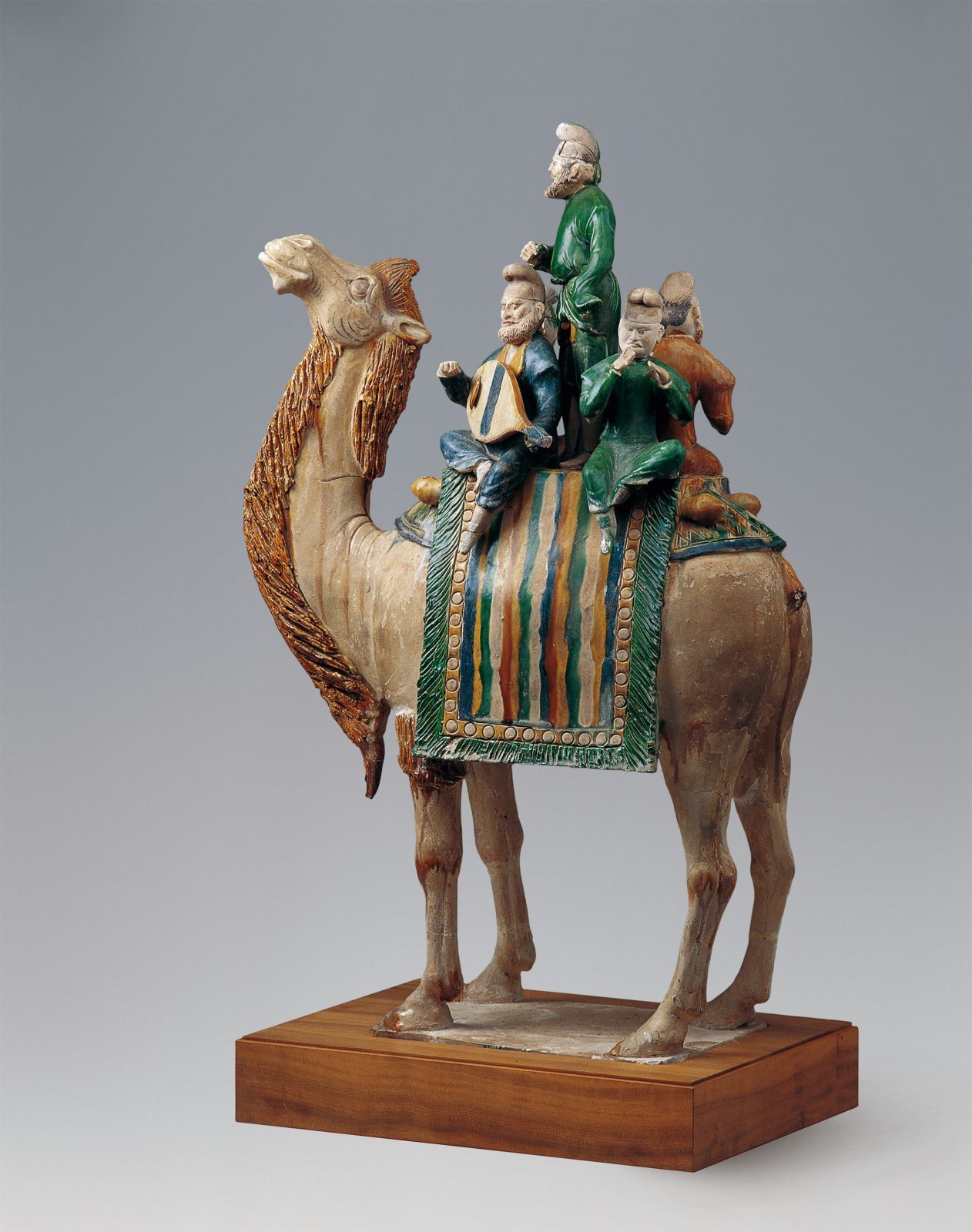
Tang Sancai Bactrian Camel with Musicians
618 – 907 CE  ·  Tang Dynasty  ·  China

The Golden Age
of Polychrome
Clay

How a dynasty's imperial confidence, cosmopolitan obsessions, and mastery of lead-fluxed fire produced the most vibrant ceramic art the medieval world had ever seen.

5
Kiln Networks
800°
Firing Temp.
755
Year of Rupture
Scroll to explore
唐三彩· Three-Color Glazed Earthenware· Tang Dynasty China
Introduction

A Three-Dimensional
Encyclopedia of Medieval China

Tang Sancai唐三彩 -- literally "Tang three-colors" -- "three-color" glazed pottery -- sits at the intersection of the Tang Dynasty's economic prosperity, complex funerary belief systems, and appetite for foreign aesthetics. These vividly colored, low-fired earthenwares were manufactured primarily as mingqiSpirit goods for aristocratic burials -- spirit goods for the elaborate burials of the Tang aristocracy.

Yet to categorize them merely as burial accessories drastically understates their historical utility. Tang Sancai captures foreign merchants' fashions, armored cavalry, mythological beasts that guarded the underworld, and transcultural vessels that graced elite banquet tables.

Loading artifact...
Camel with Musicians, Xianyu Tinghui Tomb 723 CE🏺'">
Camel with Musicians
Xianyu Tinghui Tomb, 723 CE
01
Ceramic Science

From Ash Glaze to
Polychrome Lead

The dazzling aesthetic of Tang Sancai was the culmination of millennia of empirical experimentation. The fundamental challenge is glaze formulation: a vitreous coating that fuses to the clay body during firing.

c. 1600 – 1046 BCE
Shang Dynasty -- High-Fired Ash Glazes
Calcium-rich plant ash produced proto-celadons requiring temperatures exceeding 1200°C -- difficult to sustain and prone to warping.
206 BCE – 220 CE
Han Dynasty -- Lead Oxide Discovery
Introduction of lead oxide as a flux dropped the melting point to 700-800°C, enabling glossy glazes on burial goods -- limited to monochromatic greens and amber browns.
Late 7th Century CE
Tang Dynasty -- The Polychrome Leap
Refining lead glaze over a pure white kaolinitic slip unlocked a brilliant chromatic palette. The term sancai reflects the archetypal green, amber-yellow, and creamy off-white -- though the palette exceeded three colors.

Rather than suppressing the glaze's natural fluidity, Tang potters elevated it to high art -- allowing gravity to draw molten glass downward, freezing the kinetic energy of the kiln fire onto the finished object.

Metallic Oxide Colorants
Cu Oxide
Green
Fe Oxide
Amber
Mn Oxide
Purple
Co Oxide
Cobalt
Kaolin
White
Manufacturing Process

Two firings required: first a biscuit firing to harden the kaolin body; then a glost firing at 750-850°C where lead glazes became extremely fluid, running organically down sculptural forms.

02
Archaeometric Provenance

The Five
Kiln Networks

Lead isotope ratio analysis and trace element mass spectrometry have revealed a highly organized network of specialized kilns whose geographic distribution corresponds directly to the shifting loci of imperial power.

Major Sancai Kiln Complexes

Archaeometric Chemical Signatures
Kiln ComplexLocationPeak ProductionKey Chemical Signatures
Gongyi (Huangye) Kiln
Henan
Near Luoyang, Eastern CapitalEarly-Mid Tang (pre-755 CE)Distinctive lead isotope ratios from local ore. Distinct Cesium vs. Barium ratios. Most critical Sancai center.
Huangpu (Huangbao) Kiln
Shaanxi
Near Xi'an (Chang'an)Prospering Tang (649-756 CE)High Tin (SnO2) in green glazes indicating recycled bronze. Distinct Cr/La ratios.
Liquanfang Kiln
Shaanxi
Within Chang'an itselfMid-TangLoessic clay bodies distinguishable from Henan materials by trace element analysis.
Neiqiu Kiln
Hebei
Hebei ProvinceMid-TangIdentifiable by specific trace levels of Strontium (Sr) and Silver (Ag) within the glaze matrix.
Qionglai Kiln
Sichuan
Sichuan Province, SouthwestLate TangEmerged following post-rebellion decentralization; served the southern territories.
Key Finding -- Internal Trade

A large percentage of Tang Sancai wares unearthed from high-status tombs in Chang'an dating prior to 705 CE were not produced locally. Their lead isotope signatures prove they were manufactured at the Huangye kiln in Luoyang and transported hundreds of miles westward -- highlighting an incredibly robust logistics network.

03
Hu-Han Cultural Synthesis

The World Converges
on Chang'an

The Tang capital of Chang'an was the largest city in the eighth-century world, dwarfing contemporary Baghdad and Byzantium. Its western markets were flooded with expatriates from Turkic, Iranian, Islamic, and Indic spheres -- creating intense cultural syncretism.

The Tang elite developed a veritable obsession with the exotic, known as "Hu" culture. Rather than viewing foreign elements with suspicion, they eagerly assimilated fashions, music, dances, polo, and culinary habits from Sogdiana, Sasanian Persia, and the Turkic steppes.

1,000,000
Chang'an population at peak
70+
Nations in city markets
Foreign Influences on Sancai Iconography
Sasanian Persia
Metalwork Forms
Pearl-shaped ewers, silver flask profiles, and Parthian-shot archers translated from Iranian luxury goods into glazed ceramic.
Sogdiana
Musicians & Merchants
Sogdian entertainers from Samarkand were highly prized; their pointed caps and robes appear throughout Sancai figurines.
Buddhist India
Lokapala Guardians
Buddhist Heavenly King iconography absorbed into secular tombs -- demon-trampling warriors in full martial regalia.
Greco-Roman World
Amphora Form
Mediterranean amphora silhouettes adopted and Sinicized -- utilitarian handles replaced with sculptural Chinese dragons.
Turkic Steppes
Polo, Horsemanship & Equestrian Culture
Polo became a Tang elite obsession; Sancai horses are depicted with elaborate Central Asian trappings and cropped manes reflecting steppe traditions.
04
Eschatology & Economics

The Afterlife
Must Be Furnished

The prevailing Tang belief held that the human soul was dualistic. The hunThe ethereal soul that ascended to heavenly paradise ascended to paradise, while the poThe earthly soul tethered to the corpse within the tomb remained in the tomb -- requiring sustenance, entertainment, protection, and reaffirmation of social status.

Tombs were conceived as elaborate subterranean palaces, meticulously furnished with mingqi -- spirit goods. Before sealing, the brilliantly colored Sancai figures were paraded through the streets of the capital on open carts, providing a public display of filial piety and political clout.

Mingqi served a dual purpose -- they were as much for the living as they were for the dead.

Sumptuary Laws -- Imperial Edicts
90
Max figures per official
30cm
Max legal height
Archaeological Reality

These laws were flagrantly and universally ignored. Many excavated figures stand well over one meter tall. Cost -- never fear of legal reprisal -- was the true limit.

Tang Sancai horse and rider
Horse and Rider, Tang dynasty, early 8th century -- Metropolitan Museum of Art
05
Visual Analysis

Masterpieces of the
Subterranean Palace

The iconographic repertoire of Tang Sancai is vast -- a four-part typology of apotropaic tomb guardians, beasts of burden, foreign attendants, and transcultural vessels. Click any piece to explore in detail.

Camel with Sogdian Musicians
Silk Road Iconography
Bactrian Camel, Tang Dynasty
Metropolitan Museum of Art, Acc. 1991.253.13
Lokapala Tomb Guardian
Apotropaic Guardian
Tomb Guardian Figure, Tang Dynasty
Metropolitan Museum of Art, Tang dynasty 618-907 CE
Tang Sancai Horse
Equestrian Prestige
Horse, Tang Dynasty
Metropolitan Museum of Art, Acc. 1991.253.12
Phoenix-Headed Ewer
Transcultural Vessel
Phoenix-Headed Amphora (Ewer)
Metropolitan Museum of Art, Acc. 1991.253.4
Dragon-Handled Amphora
East Meets West
Amphora with Dragon-Shaped Handles
Metropolitan Museum of Art, Acc. 1984.483.3
Typological Analysis

The vanguard of the tomb's defense consisted of pairs of Zhenmushou (Earth Spirits) -- fantastic hybrid beasts with monstrous feline or humanoid masks, sharp fangs, flared wings, and hooved feet. The chaotic pooling of amber, green, and white glazes accentuates their otherworldly ferocity.

Flanking them were Lokapalas (Heavenly Kings) -- fearsome armored guardians adopted directly from Buddhist iconography. Their inclusion in secular aristocratic tombs highlights the deeply syncretic nature of Tang religious belief.

Horses were the ultimate symbol of martial prowess and aristocratic leisure. Sancai horses are depicted with animated postures -- prancing, rearing, turning their heads -- adorned with elaborate gold-painted trappings and cropped manes.

The Bactrian camel was the indispensable engine of the Silk Road, carrying up to 120 kilograms across inhospitable terrain. The "Camel with Musicians" from the tomb of Xianyu Tinghui (723 CE) depicts five Sogdian musicians atop the load -- the hollow construction of such figurines represents a triumph of ceramic engineering.

Among the most striking figures are Central Asian and Near Eastern grooms depicted with deliberately exaggerated features -- dark skin, curly hair, deep-set eyes -- clothed in green Central Asian coats with amber lapels and high boots. The presence of foreign servants in a Chinese tomb was the ultimate status symbol, physically manifesting the deceased's dominion over the known world.

The Phoenix-Headed Ewer features a flattened, pearl-shaped body directly mimicking hammered Iranian silver flask profiles -- molded in two clay halves and joined along a vertical seam. One side depicts a dancing phoenix; the reverse features a mounted archer executing a Parthian shot, drawn from Western Asian ornamental tradition.

The Dragon-Handled Amphora demonstrates the Sinicization of a Greco-Roman shape -- the Mediterranean amphora's silhouette adopted faithfully, but utilitarian handles replaced by sculptural Chinese dragons biting into the cup mouth-rim.

06
755–763 CE

The An Lushan Rebellion &
The Rupture of the Golden Age

The unparalleled production of monumental Sancai ceramics was inextricably linked to the stability and wealth concentration of the High Tang period. This golden age was violently shattered in the winter of 755 CE.

An Lushan -- a provincial military governor of Turkic and Sogdian descent -- capitalized on Emperor Xuanzong's distractions to mobilize 150,000 troops, seize the Grand Canal, capture Luoyang, and force the Emperor's flight to Sichuan.

Although the dynasty eventually suppressed the revolt by 763 CE, the demographic, psychological, and economic devastation was absolute. The eight-year civil war led to permanent decentralization of power to regional warlords.

755
An Lushan launches revolt
150,000 troops mobilized; Grand Canal seized; Luoyang falls within weeks.
756
Chang'an falls; Emperor flees
Emperor Xuanzong abandons the capital for Sichuan. Yang Guifei executed at Ma Wei.
757
An Lushan assassinated; capitals recaptured
Uyghur cavalry assists Tang forces. Both Luoyang and Chang'an retaken.
763
Rebellion suppressed -- Tibet seizes Chang'an
The Tibetan empire briefly occupies the capital. Tang power never fully recovers.
post
Monumental Sancai production ends
Kilns in Henan and Shaanxi -- in the heaviest fighting -- were disrupted or destroyed. The impoverished aristocracy could no longer afford lavish funerals. Elite taste shifted permanently toward subdued celadons and white porcelains.
07
Cross-Cultural Transmission

A Ceramic Revolution
Radiates Outward

Despite the abrupt internal collapse of the monumental mingqi industry, the aesthetic innovations of Tang Sancai cast an enduring shadow over global ceramics. Through the Maritime Silk Road, Tang ceramics were exported in staggering quantities -- the Belitung shipwreck, a 9th-century Arab dhow, carried over 60,000 Chinese ceramics when it sank.

🕌
Abbasid Persia & Iraq
Persian "Splash Ware"
Sancai shards at Samarra and Nishapur inspired Islamic potters to develop splash-glazed earthenwares combining colored lead glazes with sgraffito Kufic calligraphy.
Nara Period Japan
Nara Sancai
The Japanese imperial court adopted the identical low-temperature lead glaze technique, adapting it for Buddhist ritual vessels at Todaiji.
🏛
Korea -- Silla Kingdom
Silla Sancai
Parallel technological transfer to the Korean peninsula created the Silla three-color tradition, cementing the regional dominance of polychrome glazed aesthetics.
🏯
Ming & Qing China
Imperial Revival
The Liao and Jin dynasties resurrected the three-color palette for nomadic elites. Qing emperors ordered the classic palette applied to pristine porcelain bodies -- a deliberate antiquarian homage.
Loading artifact...
Tang dynasty ceramic figure
Civil Official (Foreign Figure in Tang Court Dress) -- Metropolitan Museum of Art, Acc. 11.83.2
The Belitung Shipwreck

An Arab dhow that sank off Belitung island in the 9th century was carrying over 60,000 Chinese ceramics destined for Abbasid markets -- the most vivid single illustration of the Tang maritime export trade.

唐三彩

Tang Sancai serves as an enduring, three-dimensional monument to the cosmopolitanism of the Silk Road. By enthusiastically incorporating the metallurgical forms of Sasanian Persia, the musical traditions of Sogdiana, and the physical visages of the myriad foreigners who walked the bustling streets of Chang'an, Chinese potters created an art form that was simultaneously deeply indigenous and universally inclusive.

Although the golden age of monumental Sancai was tragically truncated by the An Lushan Rebellion, the shockwaves of its invention reverberated from the imperial temples of Nara to the workshops of Abbasid Persia -- a timeless testament to an era when China embraced the world.

Tang Dynasty · 618–907 CE · China