Introduction
Authentication is fundamentally an evidentiary exercise. In the art and antiquities market, the misinterpretation of a single analytical finding can result in the misidentification of an object, significant financial loss, flawed scholarship, and the continued propagation of unsupported conclusions. Scientific analysis is important, but only when its results are interpreted within their proper historical, archaeological, cultural, conservation, and scientific context. Accordingly, the authentication process does not seek certainty, but the highest degree of confidence that can reasonably be supported by the available evidence.
The need for a structured authentication framework is not merely theoretical. Recent legal scholarship has emphasized that authentication remains one of the art market's most vulnerable areas because expert opinion frequently operates within a culture of trust, confidentiality, opaque procedures, inconsistent documentation, and uneven access to scientific analysis. In such an environment, a transparent methodology that integrates provenance research, connoisseurship, scientific testing, documented reasoning, and explicit recognition of evidentiary limitations is not simply good practice—it is an essential safeguard.
Definitions
- Authentication: Determines whether an object is genuinely what it claims to be.
- Identification: Determines what an object is within its cultural, functional, and material taxonomy.
- Interpretation: Explains what the object meant within its original historical and cultural context.
- Evidence: Information, observations, documentation, analytical results, or material characteristics that support or contradict a hypothesis regarding an object's history or authenticity.
- Scientific Interpretation: Explains analytical results within their historical, archaeological, conservation, cultural, and scientific context to determine what they reveal—and do not reveal—about the object's materials, manufacture, age, history, use, conservation, and authenticity.
- Finding: A conclusion drawn from one or more observations after evaluation and interpretation within the appropriate historical, archaeological, conservation, cultural, and scientific context.
Guiding Principles
- Objects are historical documents. Their value lies not only in their aesthetic, cultural, or economic significance, but also in the historical information they preserve. Every authentic object has the potential to preserve, expand, refine, or challenge our understanding of the past.
- Authority should follow evidence—not precede it. Reputation, publication, institutional acceptance, and market value should emerge from transparent evidence and sound reasoning, not substitute for them.
- Professional due diligence Authentication protects more than collectors, museums, or markets. It safeguards the integrity of the historical record upon which scholarship, cultural understanding, and future research depend.
- Scholarship must remain self-correcting. The objective is not absolute certainty, but an increasingly accurate understanding of the past. As new evidence emerges and analytical methods improve, responsible scholarship must remain willing to revisit, refine, and, when necessary, revise earlier conclusions.
- Transparency is the foundation of trustworthy scholarship. Methods, assumptions, evidence, limitations, and reasoning should be presented clearly enough that others can independently evaluate, reproduce, challenge, or improve the conclusions.
From Observation to Determination
Investigation produces observations.
Observations become evidence only after their reliability and relevance have been evaluated.
Evidence becomes findings only after interpretation within the appropriate historical, archaeological, cultural, and scientific context.
Those findings are then collectively evaluated to support—or fail to support—a determination.
Professional Skepticism and Independent Verification
Throughout the authentication process, every material assertion should initially be regarded as a working hypothesis, not an established fact. This applies equally to provenance, attribution, age, stylistic assessments, scientific testing, publication history, exhibition records, and market narratives.
Professional skepticism is neither cynicism nor distrust. It is the disciplined practice of critically evaluating evidence, recognizing uncertainty, considering reasonable alternative explanations, and assigning confidence proportional to the quality, quantity, and independence of the supporting evidence.
Independent verification should be sought whenever practical, particularly for claims that materially influence an object's authenticity, cultural significance, legal status, or financial value. As conclusions become more consequential, the expectation for corroborating evidence correspondingly increases.
Secrecy, misinformation, and deliberate subterfuge continue to characterize parts of the tribal art market, where financial incentives, incomplete provenance, private transactions, and asymmetries of knowledge can reward opacity. In this environment, specialized expertise is a powerful asset, transparency is often the exception rather than the rule, and ignorance can prove extraordinarily expensive. Accordingly, every material assertion should be regarded as a hypothesis requiring supporting evidence rather than a conclusion requiring belief. Evidence does not speak for itself. It acquires meaning only through disciplined interpretation within the appropriate historical, archaeological, cultural, conservation, and scientific context.
The Authentication Process
The Authentication Process establishes the minimum professional considerations that must be addressed when evaluating cultural objects. The process recognizes that constraints may limit the extent of an investigation, but those constraints must be identified, disclosed, and considered when assessing the reliability of any final determination.
Upon completion of the evaluation process, these constraints must again be clearly disclosed and ultimately govern the veracity and reliability of any determination.
Process Overview
The process of authentication involves many distinct steps that are intimately linked and completely interdependent. The initial steps evaluate the provenance of an object, its documentation, and any prior conservation or analysis efforts. Other steps evaluate the object itself on the basis of artistic qualities, stylistic norms, variations, techniques, and materials. Comparative research and the identification of applicable analytical techniques are also essential components of the process—applicable analytical techniques should be selected because they address specific investigative questions or competing hypotheses.
Authoritative Sources must be identified and consulted. Research into the potential for and frequency of forgeries within the relevant areas must also be completed. All of this information is then analyzed to guide the scientific analysis process, which further supports or supports or weakens the proposed attribution. Scientific testing alone cannot establish whether an object is authentic or inauthentic definitively, although it is often useful in detecting fakes, alterations, and damage. Similarly, no single step in the Authentication Process is generally conclusive.
Authentication is an exercise in evidentiary integration rather than evidentiary voting. Conflicting evidence should not be resolved by counting the number of favorable or unfavorable observations. Instead, each finding should be evaluated according to its reliability, relevance, independence, and explanatory power within the context of the object under investigation.
Observations become findings only after they have been interpreted within the appropriate evidentiary context of the investigation.
Core Standards
Provenance Research
The first step in evaluating the authenticity of an object is a rigorous evaluation of its provenance and documentation. Although this process is often difficult, it is essential to establish the known history of the object in order to support the authentication and dating processes. Where possible, this information should include the exact date, location, and circumstances of the object’s collection, and the identity of the collector supplemented by a complete history of the object through the chain of ownership.
Provenance that cannot be reasonably verified or is completely absent may cast serious doubt on an object's authenticity. Although weak provenance does not establish inauthenticity, it increases the burden placed upon every subsequent stage of the investigation and may ultimately leave authenticity impossible to determine. Importantly, there are instances where objects are both scientifically consistent and stylistically correct yet are nevertheless modern forgeries. Ultimately, provenance is not merely another category of evidence; it establishes the evidentiary context within which subsequent observations and analytical results must be interpreted.
Conservation History
A formal Condition Report prepared by a qualified Conservator is a standard requirement and typically serves as the starting point of any evaluation. If an object has been conserved, restored, or previously the subject of analysis, it is critical that this work is thoroughly documented and that the documentation accompanies the object through the chain of ownership.
For example, some conservation treatments and analysis techniques, such as computed tomography and radiography, may alter the effectiveness or completely limit the ability to perform certain authentication and dating procedures. In addition, some materials that are routinely used during the course of conservation or cleaning may falsely, or sometimes correctly, be interpreted as signs of fakery or alteration.
Authoritative Sources
The identification of Authoritative Sources is a critical step in the Authentication Process. Authoritative Sources help provide the investigative framework, identify applicable methods, and provide essential comparative context. However, their conclusions must always be evaluated against the object-specific evidence. For the purposes of authentication, Authoritative Sources fall into three categories:
- Recognized experts. Experts at analyzing the object in question must be identified and consulted. The qualifications of these individuals must be carefully reviewed and should be able to withstand reasonable scrutiny; multiple experts in each area should be consulted.
- Scholarly References. Reference materials that support the analysis process need to be identified and reviewed. Peer-reviewed scientific journals and scholarly textbooks are typically excellent resources. Publications that illustrate unprovenanced objects or objects that have not been appropriately studied must be avoided. Web references that cannot be reliably tied back to Authoritative Sources should not be relied upon. Typically a diligent review of scholarly literature and its accompanying references or bibliographies will identify the appropriate resources.
- Reference collections. Reference collections should consist primarily of well-documented objects with the strongest available provenance and scholarly support. Collections that also include inauthentic or altered objects with well-documented records on how they were identified/detected may also be helpful.
Research Planning
Research Planning begins by utilizing the full complement of Authoritative Sources including experts in the field—art, archaeology, science, etc.—who have a solid background in analyzing the specific type and style of the object in question. This collective knowledge and research will define which analysis techniques should be employed and will become the basis for the evaluation and interpretation of results.
Scientific Analysis
Applicable analysis techniques. Every object presents its own unique set of requirements for analysis. Authoritative Sources must be consulted to guide in the selection of appropriate analytical techniques. Wherever possible, multiple techniques should be used to corroborate results and test interpretations. Testing techniques that might impact or limit future analyses need to be carefully considered before use. One potential issue may be the lack of consent for analysis methods that affect the object; e.g., taking required samples, computed tomography (CT) imaging, radiographs, etc. In instances where the owner will not allow the object to be thoroughly tested and where this type of testing is the only means to help authenticate the object, no determination can or should ever be made.
Scientific analysis. Analyses should be performed by qualified individuals observing all of the protocols and quality standards appropriate to the techniques employed. The report for each test performed should not only document the findings and conclusions, with appropriate descriptions, but should also document the equipment and methods employed to produce the results. The limitations of the method, including any exposure to fakery, must be fully explained. Scientific analyses do not replace expert judgment; they constrain, inform, and test it.
Critical to this process is the ability to differentiate natural vs. artificially induced effects. If an attribute is found to be consistent with authenticity but cannot be differentiated from effects that can be artificially, or otherwise, created, it cannot be given the same weight and must be considered inconclusive. However, the issue of differentiation must not discourage appropriate analysis, as most testing is geared toward the identification of attributes that are known to be inconsistent with authentic examples. Rigorous testing should systematically eliminate reasonable alternative explanations, thereby increasing confidence without claiming proof. Again, Authoritative Sources must be consulted to guide in the selection of the appropriate and applicable analytical techniques.
In addition, the precision and detection limits of the techniques and equipment must be fully disclosed. The standard that should be applied to the testing report is that it must contain sufficient detail to facilitate auditing by a qualified third party who could verify the methodology, technique, results, and interpretation. Reports that do not demonstrate the applicability of the testing technique or fail to relate results to established standards should be considered invalid. Reports that offer data or conclusions with no explanation of how they were derived must also be considered invalid. The final step in the scientific analysis process is to work with Authoritative Sources to interpret the results of the analysis/testing correctly and accurately compare them with definitive sources and/or statistically relevant expected norms.
Scientific testing can help address historical questions when those questions are framed as testable material hypotheses. It does not, by itself, supply the full historical interpretation.
Final Determination
The final step in the Authentication Process is to make a determination. The determination must be made by a qualified individual capable of interpreting and weighing all of the available evidence as produced by the various authentication steps. An important aspect is to determine whether enough data exists to support a determination. A determination of “authentic” should never be made on the basis of a lack of evidence to the contrary. The evidence needs to support the determination. The degree of confidence assigned to a determination should remain proportionate to the quality, quantity, consistency, and independence of the supporting evidence. In instances where results can be considered ambiguous or inconclusive, they should be stated as such, with no finding of “authentic.”
Applying the Authentication Process – An Abbreviated Example
The following investigation illustrates how the authentication process is applied in practice. It is intended to teach the interpretation of evidence rather than merely list analytical techniques. The examples are drawn from the examination of Benin material but the principles apply broadly to the authentication of cultural objects.
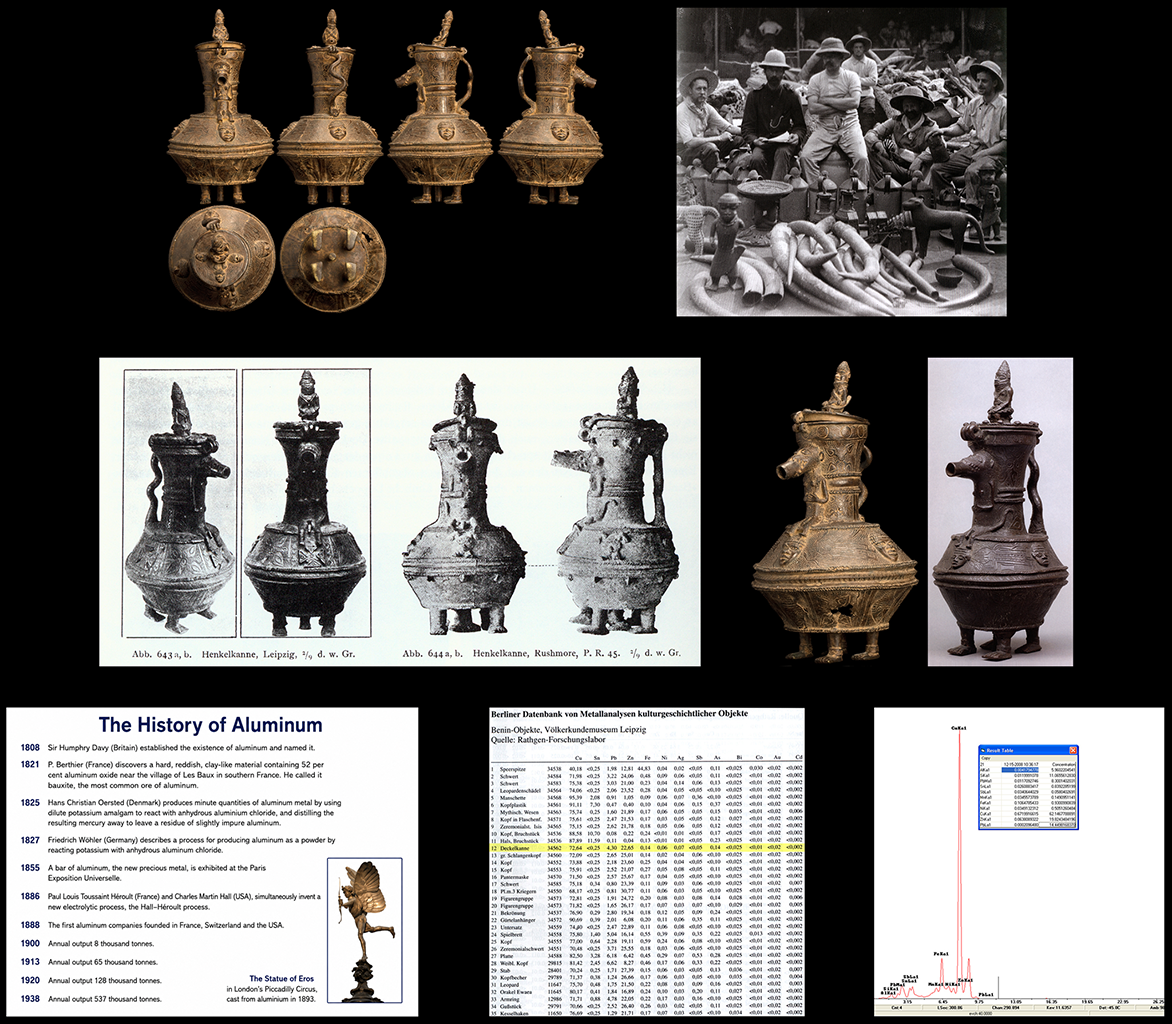
Step-by-Step Authentication Process
The following abbreviated workflow illustrates how the Authentication Process is applied in practice. Although the examples are drawn from the examination of Benin material, the methodology is broadly applicable to the authentication of cultural objects. The workflow intentionally reflects a conservative, best-practices approach. Not every analytical technique will be appropriate for every object, nor will every investigation require the same depth of analysis. Nevertheless, each step should be considered during the planning stage of an investigation, and any decision to modify, defer, or omit a step should be deliberate, justified, and documented rather than the result of oversight or convenience.
Clarification on Material Composition: While universally recognized as the “Benin Bronzes,” historical metallurgy confirms these artifacts are predominantly copper alloys and cast brass rather than true bronze. To maintain alignment with established global cataloging and academic reference, this paper uses the standard nomenclature “Benin Bronzes,” though it acknowledges their accurate scientific classification as brass and copper.
Phase I — Documentary Investigation
1. Provenance Verification
ObjectiveDocument and evaluate the available ownership and documentary history. As required, perform forensic examination of original documents to verify authenticity, assess provenance claims, and identify any alterations, inconsistencies, or gaps in the historical record.
Actions- Document the claimed or known origin and chain of ownership.
- Utilize archives, databases, museum records, auction catalogues, and previous research.
- Review the complete publication history and verify that the object's condition has remained consistent through time.
- Utilize Google Images and Google Lens as discovery tools to identify additional publication history, duplicate photographs, auction records, and ownership references for subsequent verification.
Emerging AI capabilities can now generate plausible provenance narratives, fabricate supporting documentation and correspondence, alter or create convincing photographs, simulate historical records, and assist in producing increasingly sophisticated false or misleading evidence. At the same time, AI also provides investigators with powerful new capabilities for research, comparative analysis, document examination, image analysis, anomaly detection, and the identification of inconsistencies that previously would have been impractical to detect. Digitally discovered records, image matches, and AI-assisted findings should be treated as investigative leads until independently verified.
2. Condition Analysis
ObjectivePrepare a formal Condition Report that documents the object's present condition and evaluates any prior interventions. The report should record structural integrity, surface condition, evidence of past repairs or treatments, and identify any conditions requiring immediate stabilization, conservation treatment, or further investigation.
Actions- Assess the current physical condition of the object.
- Document wear, damage, repairs, restorations, and conservation treatments.
- Review previous analytical testing, sampling, conservation treatment, handling, display, and storage history.
- Evaluate whether conservation measures are needed before continuing with further examination.
Phase II — Preliminary Examination
3. Microscopic Analysis
ObjectiveDocument casting technology, microstructure, corrosion morphology, and age-related surface changes before procedures that may alter or contaminate the object.
Actions- Conduct microscopic examination before destructive, invasive, contaminating, or radiation-based procedures when such procedures may alter the evidentiary condition of the object.
- Examine alloy microstructure to determine crystal formation patterns and casting sequence (single pour vs. assembled components).
- Identify lost wax indicators such as casting flaws, trapped air bubbles, and finishing tool marks.
- Assess corrosion morphology to distinguish authentic long term aging from modern fabrication.
4. Casting Core Assessment
ObjectiveWhere thermoluminescence (TL) testing may be appropriate, identify, document, and preserve suitable core or ceramic material before procedures that may alter, contaminate, irradiate, heat, or otherwise compromise the sample.
Actions- Identify, document, and preserve visible casting-core material; collect samples only when justified by the analytical plan and research objectives.
- Search for concealed TL sampling opportunities.
- Utilize borescopic examination where appropriate.
5. Thermoluminescence (TL) Testing
If applicableIf applicable, submit each TL sample to a qualified laboratory with demonstrated expertise in thermoluminescence dating of archaeological ceramics and clay core materials. When multiple samples are collected, request that each sample be processed and evaluated independently so that the results from individual sampling locations remain distinguishable. Request screening for modern adhesives, consolidants, binders, evidence of contamination, artificial irradiation, and other factors that may invalidate, qualify, or complicate interpretation of the results.
TL testing is applicable to Benin Bronzes because the lost-wax casting process used clay cores that were fired during manufacture. These fired core materials can retain a measurable thermoluminescent signal that accumulates over time, allowing the approximate time at which the clay core was last fired to be estimated.
TL results may provide evidence relevant to the claimed date of manufacture. However, a TL date establishes the age of the tested material—not necessarily the age, integrity, or authenticity of the object as a whole.
In some cases, a laboratory may be unable to reach a reliable conclusion because of sample characteristics, insufficient signal, contamination, prior treatment, or other analytical limitations. Such findings should generally be considered neutral unless additional evidence demonstrates otherwise and should not be interpreted as evidence that an object is either authentic or a forgery.
Analytical results should therefore be interpreted within the broader archaeological, conservation, historical, and forensic context of the object.
WarningAncient or age-appropriate materials are occasionally incorporated into modern forgeries in an effort to obtain a misleading or fraudulent TL report. Independent processing of each sampling location and appropriate screening for modern adhesives, consolidants, binders, or other contaminants may help identify some forms of this deception but should not be considered foolproof.
6. AMS Radiocarbon Sampling (e.g., Charcoal or Other Preserved Organics)
If applicableCollect and preserve samples suitable for Accelerator Mass Spectrometry (AMS) analysis.
WarningA radiocarbon date may establish the age of the sampled organic material—not necessarily the age of the surrounding object or its date of manufacture.
7. Analytical Photography and Technical Imaging
ImportantFully document the object using descriptive photography, macro/micro photography, dark-field imaging, ultraviolet fluorescence or reflectance imaging, and infrared reflectography (IRR) as appropriate.
8. Iconographic and Stylistic Assessment
ObjectiveEvaluate the object against authoritative stylistic references.
Actions- Examine artistic motifs and stylistic characteristics.
- Compare with authenticated Benin, Ife, or Udo examples.
- Perform an attribute-by-attribute comparative assessment using authoritative Benin references, including Dark (1975), Willett (1994), Riederer (2008), Junge (2008), Read (1899), von Luschan (1919), and other relevant sources as applicable.
9. Contextual and Cultural Interpretation
ObjectivePlace the object within its appropriate historical, cultural, and functional context.
Actions- Investigate cultural significance.
- Examine ceremonial, functional, and historical use.
- Evaluate regional historical associations.
- Consider traditional patterns of manufacture, use, maintenance, repair, storage, and deposition that may influence the object's present condition and evidentiary record.
- Distinguish cultural plausibility from object-specific proof.
Phase III — Scientific Investigation
Once documentary research, stylistic assessment, and preliminary examinations have been completed, additional scientific analyses should be selected only when they address unanswered questions or materially strengthen the evidentiary record.
10. Patina Analysis
ImportantBegin with non-invasive visual, microscopic, and photographic examination. Where justified, proceed to targeted solubility testing, X‑Ray Diffraction (XRD), Fourier‑Transform Infrared Spectroscopy (FTIR), Raman spectroscopy, SEM-EDS, GC-MS, or other methods appropriate to the material question. For example, FTIR may identify organic surface coatings and fatty acid salts resulting from past conservation treatments, including beeswax, oils, and protective waxes applied by dealers, collectors, conservators, or museums. FTIR can also detect copper carboxylates (metal soaps) formed through reactions between copper corrosion products and organic acids associated with waxes, oils, or other conservation materials. Note that FTIR identifies chemical compounds; it does not, by itself, establish when those compounds were deposited. XRD can characterize crystalline phases present in corrosion products, patinas, accretions, core material, and, where applicable, metal alloy phases, helping distinguish corrosion mineralogy and surface alteration pathways.
11. Radiation Exposure and Dosimetry Controls
Document all prior and proposed radiation-based examinations, including radiography, CT, and laboratory irradiation where relevant, because cumulative exposure may affect later dose-sensitive analyses. Complete any radiation sensitive sampling before undertaking any work that may influence dose assessments.
12. X-Ray Fluorescence (XRF)
ObjectiveX-ray Fluorescence (XRF) spectroscopy provides non-destructive, elemental analysis. It measures base metals (e.g., copper, zinc, lead, tin) and trace impurities, characterizing the surface elemental composition and trace impurities. Results are limited to the immediate surface, which may be contaminated.
ActionConduct XRF spot analysis or elemental mapping according to a documented sampling plan. Record instrument type, calibration, geometry, acquisition parameters, detection limits, surface condition, and whether readings represent metal, corrosion, patina, restoration material, soil, or contamination.
13. High‑Energy X‑ray and CT Imaging
ImportantPerform high‑energy X‑ray or CT imaging to reveal internal structural and manufacturing features of the casting. CT can document variations in wall thickness characteristic of the lost‑wax process, and high‑energy imaging can identify preserved core materials and the metal pins, chaplets, armatures, joins, fills, repairs, and other internal features relevant to manufacture, restoration, or later alteration. Document scanning parameters, voxel size or resolution, beam-hardening artifacts, reconstruction assumptions, and any limits on interpretation. CT and radiography should be interpreted in relation to manufacturing technology, restoration history, material density, joins, pins, fills, repairs, and internal discontinuities.
14. Quality Assurance
Before proceeding further, re-review authoritative sources, verify compatibility between analytical results and known authentic examples, and confirm that the proposed analytical pathway remains appropriate.
15. Metallography
If applicableIf justified, perform microdestructive metallographic sampling using procedures that preserve microstructural integrity and avoid contamination. Interpret microstructure in relation to casting, working, annealing, corrosion, repair, and modern fabrication pathways.
Actions- Repeat XRF where appropriate.
- Conduct final microscopic examination.
- Prepare metallographic mounts using non-conductive, non-contaminating materials.
- Complete metallographic analysis.
16. Scanning Electron Microscopy coupled with Energy Dispersive X-Ray Spectroscopy (SEM-EDS)
If applicablePerform mapped SEM-EDS. Evaluate aluminum, manganese, elemental concentrations, and elemental context. SEM-EDS can help characterize elemental composition and spatial relationships at high resolution. When combined with optical microscopy, SEM imaging, and metallographic context, it may help distinguish metallic aluminum inclusions from aluminum-bearing oxides, corrosion products, or mineral phases. SEM-EDS results should not be interpreted without microstructural context.
17. Pb-210 Testing
If applicablePerform Pb-210 analyses and related radium-series testing. Pb-210/Po-210 analysis may identify relatively recent lead refinement because refining separates the lead from the uranium-bearing minerals and associated radium (Ra-226), breaking the natural U-238 decay equilibrium. Once refined, any remaining Pb-210 begins to decay without replenishment from Ra-226. If Pb-210 or Po-210 is detected in refined lead that contains no remaining Ra-226, the lead was likely refined within approximately the last century. Conversely, the absence of Pb-210 and Po-210 does not establish antiquity because the initial radionuclide activity is unknown and recycled lead may produce misleading results.
ImportantInterpretation also requires confirming that residual Ra-226 is absent. If Ra-226 remains, it continues to replenish Pb-210 and Po-210, preventing the decay clock from being fully reset during refining.
18. Lead Isotope Analysis
If applicablePerform lead isotope analysis where applicable to evaluate compatibility with proposed ore sources or comparative datasets. Using high-precision techniques such as MC-ICP-MS or TIMS, measure stable isotope ratios, including Pb-206/Pb-204 and Pb-208/Pb-204. Lead isotope analysis may support source attribution or identify inconsistency with proposed ore sources, but it does not date an object or establish authenticity by itself. Recycling, mixing, and overlapping ore signatures must be considered.
Phase IV — Final Evaluation
19. Legal, Ethical, and Provenance Review
Review the acquisition history for compliance with applicable cultural heritage legislation, international agreements, professional ethical standards, and institutional collecting policies. Legal ownership, ethical stewardship, and provenance expectations continue to evolve rapidly as governments, museums, and cultural institutions increasingly reexamine the acquisition histories of colonial-era collections. Recent repatriations—including Germany's return of Benin Bronzes pursuant to its 2022 Joint Declaration with Nigeria, the Netherlands' return of 119 Benin Bronzes in 2025, Switzerland's return of 18 significant Benin Artifacts in 2026, and Scotland's restitution initiatives—underscore the importance of rigorous provenance research, legal analysis, and ethical review throughout the authentication process. See the references below for representative examples.
Germany to Return Benin Bronzes
Federal Republic of Germany, & Federal Republic of Nigeria. (2022, July 1). Joint declaration on the return of Benin Bronzes and bilateral museum cooperation. https://kulturstaatsminister.de/fileadmin/user_upload/Downloads/Aufarbeiten/2022-07-01-Joint-Declaration-Benin-Bronzes.pdf
Asadu, C. (2022, December 20). Germany returns Nigerian bronzes, notes its “dark past”. Associated Press. https://apnews.com/article/africa-germany-berlin-13e1a65da1b08644d3c5d5032d24e426
Herman, A. (2022, July 5). Benin Bronzes Joint Declaration signed between Germany and Nigeria… but what about the UK? Institute of Art and Law. https://ial.uk.com/benin-bronze-joint-declaration/
Swiss Repatriation of 18 Benin Artifacts
Swiss Federal Department of Home Affairs. (2026). Restitution to Nigeria: Swiss museums return 18 major artefacts.
https://www.bazg.admin.ch/en/newnsb/NmoDpfWO7_yNQ8ugRMxRn
Artforum. (2026). Swiss museums return eighteen Benin Bronzes to Nigeria.
https://www.artforum.com/news/swiss-museums-return-eighteen-benin-bronzes-to-nigeria-1234753783/
Artnet News. (2026). Switzerland has returned Benin Bronzes as part of a growing restitution movement.
https://news.artnet.com/art-world/switzerland-returned-benin-bronzes-restitution-2785078
Dutch Repatriation of Benin Bronzes
Al Jazeera. (2025, June 21). The Netherlands returns 119 stolen sculptures to Nigeria.
https://www.aljazeera.com/news/2025/6/21/the-netherlands-returns-119-stolen-sculptures-to-nigeria
Government of the Netherlands. (2025, June 18). Benin Bronzes from the Netherlands returning home to Nigeria.
https://www.government.nl/latest/news/2025/06/18/benin-bronzes-from-the-netherlands-returning-home-to-nigeria
Associated Press. (2025). Netherlands returns looted Benin Bronzes to Nigeria.
https://apnews.com/article/benin-bronzes-netherlands-nigeria-looted-78eab1381f1e219507e2d7607ed41d4f
NPR. (2025, February 21). The Netherlands returns a Benin Bronze to Nigeria.
https://www.npr.org/2025/02/21/g-s1-50111/benin-bronze-netherlands-nigeria
Scottish Repatriation of Benin Bronzes
Museums Galleries Scotland. (2024). Returning a Benin Bronze to its rightful place: Benin City.
https://www.museumsgalleriesscotland.org.uk/sector-story/returning-a-benin-bronze-to-its-rightful-place-benin-city/
Artnet News. (2022). Glasgow museums to return Benin Bronze as part of restitution efforts.
https://news.artnet.com/art-world/glasgow-benin-bronze-restitution-2099220
BBC News. (2022). Glasgow museums to return stolen Benin Bronze.
https://www.bbc.com/news/articles/c4g2l9j0ny1o
This review is intended to identify legal and ethical considerations that may affect the authentication process or the subsequent treatment, acquisition, sale, accession, or publication of an object. It is not intended to provide legal advice or determine legal ownership. Questions involving title, ownership, cultural heritage legislation, export controls, repatriation, or related legal issues should be evaluated by qualified legal counsel before undertaking actions involving an object where ownership, provenance, or legal issues remain unresolved.
20. Final Analysis and Determination
Integrate all available documentary, stylistic, conservation, and scientific evidence before rendering an opinion. The final determination should reflect not only the analytical results, but also the strength, quality, and consistency of the entire body of evidence. As previously stated, the evidence needs to support authenticity. In instances where results can be considered ambiguous or inconclusive, they should be stated as such, with no finding of “authentic.”
The Dangers of Overinterpreting Partial Test Results
One of the greatest dangers in authentication is assigning too much weight to an individual analytical result. Every analytical method answers a specific question, but no single test answers the ultimate question: Is the object authentic?
To illustrate the problem, consider a typical Benin object. Authentic pieces associated with the 1897 Punitive Expedition have often lived remarkably complicated lives. Since the 1897 Punitive Expedition many have been damaged, repaired, restored, conserved, cleaned, repatinated, photographed, exhibited, transported, sampled, and even used to produce molds for museums, collectors, dealers, and commercial reproductions. These interventions frequently leave physical and chemical evidence unrelated to the object's original manufacture.
- Many authentic objects have been repaired, restored, or conserved one or more times.
- Surface treatments have ranged from applications of neat's-foot oil and protective coatings to aggressive mechanical or chemical stripping followed by repatination.
- Some authentic objects were used to produce molds for collectors, dealers, and museums. Evidence of mold making should therefore not automatically be interpreted as evidence of forgery.
With those realities in mind, consider the kinds of questions that limited testing naturally raises.
Question 1 — Surface Condition
You perform a basic examination of the surface and discover a “new” patina or coating that clearly does not appear to be original. Does that mean the object is fake?
Question 2 — Surface XRF
Surface XRF detects zinc, silicon, manganese, and/or aluminum in concentrations that appear inconsistent with the presumed age of the object. Does that mean the object is fake?
Question 3 — Metallography
Basic metallography reveals dezincification. Does that mean the object is genuine?
Question 4 — TL Testing
You collect what appears to be original casting-core material and TL Testing produces an age consistent with historical manufacture. Does that mean the object is genuine?
Question 5 — Stylistic Analysis
The object is stylistically convincing. Does that mean the object is genuine?
Question 6 — Provenance
Documentation states that the object came from the 1897 Punitive Expedition and a previous owner's name appears in Dark (1982). Does that establish that this is the same object and that it is genuine?
In fact, limited testing is just as capable of producing a false positive as it is a false negative. The significance of each observation depends entirely upon its context. The correct question is not “What did this test find?” but “What are all of the reasonable explanations for this result?”
Surface Condition
The surface of a genuine piece may have been altered during conservation and may ultimately be indistinguishable from that of a modern reproduction treated in exactly the same manner. A modern coating may demonstrate only that the surface has changed—not when the object was made.
Surface XRF
Compositional analysis must always be interpreted within context. Aluminum occurring as a mineral inclusion is fundamentally different from aluminum present as a metallic phase. XRF also measures corrosion products, dirt, restoration materials, repair alloys, and surface contamination. Without knowing exactly what is being analyzed, compositional data alone should never be overinterpreted.
Metallography
Many sophisticated modern reproductions employ electrochemical and other patination techniques capable of producing convincing corrosion effects that may mislead inexperienced analysts.
TL Testing
Age-appropriate casting cores have been inserted into modern castings to obtain favorable TL dates. Artificial irradiation may also produce apparently valid dates. A TL date establishes the age of the tested material—not necessarily the age of the object as a whole, the relationship of the sampled material to the object, or the authenticity of the object itself. Accordingly, sampling strategy, sample provenance, and the relationship between the tested material and the object are as important as the analytical result itself.
Stylistic Analysis
Looking correct is not enough. A disciplined, attribute-by-attribute review using authoritative references is required. Physiognomy, proportions, casting details, iconography, workmanship, and manufacturing techniques should all be evaluated systematically before stylistic evidence is given substantial weight.
Provenance
Provenance that cannot be independently substantiated should be approached cautiously. Many objects listed in Dark (1982) were never illustrated, numerous pieces have changed hands repeatedly, duplicates exist, and undocumented substitutions or “replacement pieces” further complicate provenance research.
Research Methodology and Comparative Resources
The authentication process relied upon a combination of scholarly literature, historical catalogues, museum collections, object databases, archival resources, legal authorities, and comparative image repositories. These resources served not merely as references but as integral components of the investigative methodology. Collectively, they established historical, archaeological, cultural, and legal context; supported comparative and stylistic analysis; informed provenance research and legal review; documented published examples, known variants, and comparative material; and facilitated the recognition of reproductions, restorations, alterations, and other conditions relevant to the interpretation of the evidence. Rather than serving as isolated references, these resources were used collectively to corroborate observations, evaluate competing hypotheses, and support conclusions through the convergence of independent lines of evidence.
Primary Scholarly Literature
These publications established the historical, stylistic, archaeological, and scientific framework against which the object was evaluated. The scholarly foundation for this investigation consisted primarily of the works of:
- Adewumi, A. A. (2019). Benin objects: Return of stolen objects or restitution of objects of cultural value? Ibadan Regional Law Journal, 1(2), 177–182.
- Blackmun, B. W. (2008). Late 20th century bronzes and ivories in Benin City, Nigeria. In E. Pernicka & S. von Berswordt-Wallrabe (Eds.), Original–Copy–Fake? Examining the Authenticity of Ancient Works of Art: Focusing on African and Asian Bronzes and Terracottas (pp. 151–163). Stiftung Situation Kunst; Verlag Philipp von Zabern.
- Bondarenko, D. M. (2001). Ancient Benin: Where did the first monarchs come from? Asian and African Studies, 10(2), 185–198.
- Bondarenko, D. M. (2006). Homoarchy: A Principle of Culture's Organization: The 13th–19th Centuries Benin Kingdom as a Non-State Supercomplex Society. URSS.
- Bondarenko, D. M., & Roese, P. M. (1999). Benin prehistory: The origin and settling down of the Edo. Anthropos, 94(4/6), 542–552.
- Bourgarit, D., Bassett, J. L., Bewer, F. G., Heginbotham, A., Lacey, A., & Motture, P. (Eds.). (2025). Guidelines for the technical examination of bronze sculpture. J. Paul Getty Museum.
- Bradbury, R. E. (1973). Benin Studies. Oxford University Press.
- Buxton, John A., & Rasmussen, Mark (2026a). Appraisal considerations for Tribal and Indigenous artwork. Rare Collections.
- Buxton, John A., & Rasmussen, Mark (2026b). Manufactured certainty: How misinformation enters the Tribal Art record. Rare Collections.
- Buxton, John A., & Rasmussen, Mark (2026c). Toward a standard for the characterization of the physical condition of Tribal and Indigenous artwork. Rare Collections.
- Craddock, P. T., & Picton, J. (1986). Medieval copper alloy production and West African bronze analyses. Archaeometry, 28(1), 3–32.
- Craddock, P. T. (Ed.). (2009). Scientific investigation of copies, fakes and forgeries (1st ed.). Routledge.
- Dark, P. J. C. (1973). An Introduction to Benin Art and Technology. Clarendon Press.
- Dark, P. J. C. (1975). Benin bronze heads: Styles and chronology. In D. F. McCall & E. G. Bay (Eds.), African images: Essays in African iconology (pp. 25–103, Plates 1–97). Africana.
- Dark, P. J. C. (1982). An Illustrated Catalogue of Benin Art. G. K. Hall.
- Darling, P. J. (1984). Archaeology and History in Southern Nigeria: The Ancient Linear Earthworks of Benin and Ishan. British Archaeological Reports.
- Egharevba, J. U. (1968). A Short History of Benin. Ibadan University Press.
- International Council of Museums. (n.d.). Authentication. Observatory on Illicit Traffic in Cultural Goods. https://www.obs-traffic.museum/authentication
- Jacobs, J. (1986). African Art at the Glasgow Art Gallery and Museum. African Arts, 19(2), 28–40, 90–91.
- Junge, P. (2008). Questions in dating Benin commemorative heads: Exemplified by heads from the Berlin Benin Collection. In E. Pernicka & S. von Berswordt-Wallrabe (Eds.), Original–Copy–Fake? Examining the authenticity of ancient works of art: Focusing on African and Asian bronzes and terracottas (pp. 164–177). Stiftung Situation Kunst; Verlag Philipp von Zabern.
- La Niece, S. (2005). Restoration, pastiche and fakes. In J. Lang & A. Middleton (Eds.), Radiography of cultural material (2nd ed.). Routledge.
- Lerner, R. E., Bresler, J., & Wierbicki, D. (2020). Art Law: The Guide for Collectors, Investors, Dealers & Artists (5th ed.). Practising Law Institute.
- Nevadomsky, J., Půtová, B., & Soukup, V. (2014). Benin art and casting technologies. West Bohemian Historical Review, 1, 75–103.
- Nevadomsky, J. (2017). Commentary: Cautionary Tales and Culture History in the Evolution of the Benin Kingdom: The Ogiso Era. Global Journal of Archaeology & Anthropology, 1(4), Article 555568.
- Odiahi, E. V. (2017). The origin and development of the guild of bronze casters of Benin Kingdom up to 1914. AFRREV IJAH: An International Journal of Arts and Humanities, 6(1), 176–187. https://doi.org/10.4314/ijah.v6i1.15
- Pernicka, E., & von Berswordt-Wallrabe, S. (Eds.). (2008). Original–Copy–Fake? Examining the Authenticity of Ancient Works of Art: Focusing on African and Asian Bronzes and Terracottas: International Symposium Stiftung Situation Kunst/Ruhr-University Bochum, February 17th and 18th, 2007. Stiftung Situation Kunst; Verlag Philipp von Zabern.
- Pernicka, E., Schwab, R., Loeckhoff, N., & Haustein, M. (2008). Scientific investigations of West African metal castings from a collection in Bochum. In E. Pernicka & S. von Berswordt-Wallrabe (Eds.), Original–Copy–Fake? Examining the Authenticity of Ancient Works of Art: Focusing on African and Asian Bronzes and Terracottas (pp. 80–98). Stiftung Situation Kunst; Verlag Philipp von Zabern.
- Plankensteiner, B. (Ed.). (2007). Benin Kings and Rituals: Court Arts from Nigeria. Snoeck.
- Rasmussen, M. (2008). Setting the standard for due diligence: Scientific techniques in the authentication process. In E. Pernicka & S. von Berswordt-Wallrabe (Eds.), Original–Copy–Fake? Examining the Authenticity of Ancient Works of Art: Focusing on African and Asian Bronzes and Terracottas (pp. 19–32). Stiftung Situation Kunst; Verlag Philipp von Zabern.
- Rasmussen, Mark. (2026). Authority cascade: When authority begins to outpace evidence. Rare Collections.
- Read, C. H., & Dalton, O. M. (1899). Antiquities from the City of Benin and from Other Parts of West Africa in the British Museum. Trustees of the British Museum.
- Riederer, J. (2008). The composition of brass objects from Benin. In E. Pernicka & S. von Berswordt-Wallrabe (Eds.), Original–Copy–Fake? Examining the Authenticity of Ancient Works of Art: Focusing on African and Asian Bronzes and Terracottas (pp. 99–152). Stiftung Situation Kunst; Verlag Philipp von Zabern.
- Ryder, A. F. C. (1969). Benin and the Europeans, 1485–1897. Longman.
- Schorsch, R. (1995). Corrosion and past “protective” treatments of the Benin copper alloy plaques. MRS Proceedings, 185, 805–816. https://doi.org/10.1557/PROC-185-805
- Skowronek, T. B., DeCorse, C. R., Denk, R., Birr, S. D., Kingsley, S., Cook, G. D., Benito Dominguez, A. M., Clifford, B., Barker, A., Otero, J. S., Moreira, V. C., Bode, M., Jansen, M., & Scholes, D. (2023). German brass for Benin Bronzes: Geochemical analysis insights into the early Atlantic trade. PLOS ONE, 18(4), Article e0283415.
- Usuanlele, U., & Falola, T. (1998). A Comparison of Jacob Egharevba's Ekhere Vb Itan Edo and the Four Editions of Its English Translation, A Short History of Benin. History in Africa, 25, 361–386.
- von Luschan, F. (1919). Die Altertümer von Benin. Vereinigung Wissenschaftlicher Verleger.
- Willett, F., Torsney, B., & Ritchie, M. (1994). Composition and style: An examination of the Benin “bronze” heads. African Arts, 27(3), 60–67, 102. https://doi.org/10.2307/3337202
- Willett, F., & Sayre, E. V. (2006). Lead isotopes in West African copper alloys. Journal of African Archaeology, 4. 55–90.
Historical Catalogues and Provenance Resources
These catalogues were used to reconstruct provenance, publication history, ownership history, and early collecting patterns.
Historical provenance research included the early Benin catalogues and dealer records that document the initial dispersal of objects following the 1897 Punitive Expedition. These catalogues also served as important comparative resources for object histories, publication histories, and ownership research.
- Pitt-Rivers, A. H. L.-F. (1900). Antique Works of Art from Benin. Privately printed.
- W. D. Webster catalogues (1868–1913; various editions, some illustrated).
- J. C. Stevens Auction Rooms catalogues (1898–1904; various editions, some illustrated).
- William Downing Webster records (creator records; 1897–1900).
Comparative Collections and Databases
Comparative analysis extended well beyond the traditional literature review. Museum collections, digital repositories, and archival image collections were systematically examined to identify comparable objects, publication histories, provenance relationships, stylistic variants, and other relevant material for comparative study.
-
The Van Rijn Archive of African Art (Yale University Art Gallery). https://jstor.org/site/yaleuniversitylibrary/yuag-van-rijn-archive-african-art/
Comparative object, provenance, and publication research. -
The Ross Archive of African Images. https://www.jstor.org/site/yaleuniversitylibrary/rossarchiveofafricanimages-yuag/
Comparative image research and stylistic comparison. -
The British Museum Collection Online. https://www.britishmuseum.org/collection/search?keyword=Benin%20bronzes
Includes objects and historic photographs. -
The Pitt Rivers Museum Collections Online. https://www.prm.ox.ac.uk/collections-online#/search/simple-search/Benin%20bronzes
Includes objects and historic photographs. -
The Met Collection. https://www.metmuseum.org/art/collection/search?q=benin+brass
Includes objects with details and references. -
Digital Benin. https://digitalbenin.org
Digital Benin connects information for approximately 5,285 objects across 136 institutions in 20 countries. -
Benin Bronzes in Germany. https://www.germancontactpoint.org/benin-bronzes/
This database presents an overview of the Benin-Bronzes that are held in German museums.
Discovery and Comparative Image Tools
Candidate matches were never accepted as evidence by themselves; instead, they served as investigative leads that were subsequently verified against authoritative scholarly and institutional sources.
-
Artkhade. https://www.artkhade.com/en
Comparative image, market, and provenance research. - Google Lens and Google Images (various searches).
Discovery tools used to identify visually similar objects and publication histories for subsequent verification.
Provenance, Cultural Property, and Due Diligence Resources
These resources support provenance research, due diligence, and cultural property investigations. Together, they reflect widely recognized professional standards, inform professional conduct, and provide practical guidance and reference tools for conservators, museums, appraisers, attorneys, researchers, and other cultural property professionals. Depending on an object's history, they may assist in identifying reported thefts, wartime losses, missing cultural property, legal restrictions, ownership issues, and other factors that may affect acquisition, transfer, or valuation.
- American Institute for Conservation. Code of Ethics and Guidelines for Practice. AIC. https://www.culturalheritage.org/conservation-at-work/uphold-professional-standards/code
- The Appraisal Foundation. Uniform Standards of Professional Appraisal Practice (USPAP). https://appraisalfoundation.org/pages/uspap
- International Society of Appraisers. Code of Ethics and Professional Conduct. ISA. https://www.isa-appraisers.org/about/policies/code-of-ethics
- International Council of Museums. Due diligence / good faith. ICOM. https://www.obs-traffic.museum/due-diligence-good-faith
- International Council of Museums. Ethical standards / codes of ethics. ICOM. https://www.obs-traffic.museum/ethical-standards-codes-ethics
- International Council of Museums. (n.d.). Red Lists database. ICOM. https://icom.museum/en/resources/red-lists/
- National Stolen Art File (NSAF). https://artcrimes.fbi.gov/
- INTERPOL Stolen Works of Art Database. https://www.interpol.int/en/Crimes/Cultural-heritage-crime/Stolen-Works-of-Art-Database
- Lost Art Database. https://www.lostart.de/en/start
- The Central Registry of Information on Looted Cultural Property 1933–1945. https://www.lootedart.com/home
- AfricaMuseum Stolen/Missing Objects. https://www.africamuseum.be/en/research/collections_libraries/human_sciences/stolen_missing
- International Council of Museums. (1994). Looting in Africa: One hundred missing objects / Pillage en Afrique: cent objets disparus. International Council of Museums. (ISBN 92-9012-017-7)
Provenance research is only one component of responsible due diligence. Professional standards within the conservation, museum, and appraisal professions emphasize the importance of understanding an object's history, ownership, legal status, and applicable laws before acquisition, appraisal, conservation, exhibition, or transfer. High-value works of art and cultural property may also present legal, regulatory, financial, tax, and cross-border compliance considerations that fall outside the scope of provenance and authenticity research. These issues may require review by qualified legal counsel, tax advisors, customs specialists, or financial professionals.
Final Thoughts
My work emphasizes methodological transparency, scientific due diligence, and the principle that authentication is achieved not by accumulating favorable evidence, but by systematically eliminating reasonable alternative explanations.
The observations presented in this article reflect years of scientific investigation and practical experience examining cultural objects. Their purpose is not merely to identify potential indicators of authenticity or forgery, but to encourage disciplined reasoning, thoughtful interpretation, and conclusions that remain proportionate to the available evidence. Readers should come away understanding not only what particular observations may indicate, but also what they do not necessarily mean.
The need for such an approach extends well beyond individual investigations. Recent legal scholarship and broader analyses of the international art market have similarly identified persistent concerns regarding the absence of standardized methodologies, reliance on trust and confidentiality, inconsistent documentation, conflicts of interest, increasing pressure on authentication, and the enduring lack of transparency that characterizes significant portions of the market (Adam, 2017; Bolz, 2022). These observations reinforce the importance of transparent investigative processes that integrate provenance research, connoisseurship, scientific analysis, documented reasoning, and explicit recognition of evidentiary limitations. No methodology can eliminate uncertainty, nor should certainty be its objective. The goal is to achieve the highest degree of confidence that can reasonably be supported by the available evidence while remaining open to revision as new information emerges.
Ultimately, authentication is not a search for confirmation, but a disciplined process of inquiry. Every material assertion should be treated as a hypothesis requiring supporting evidence rather than a conclusion requiring belief. Confidence should be earned through evidence, remain proportionate to the supporting evidence, and never exceed it.
Further Reading
- Adam, G. (2017). Dark side of the boom: The excesses of the art market in the twenty-first century. Lund Humphries.
- Bolz, A. (2023). A regulatory framework for the art market? Authenticity, forgeries and the role of art experts. Springer. https://doi.org/10.1007/978-3-031-18743-8