
When family life becomes difficult, finding the right environment to have important conversations can make all the difference. Mediation offers a supported, neutral space where clarity begins to emerge.
"Sometimes, the only thing needed at the start is a willingness to sit down and begin the conversation."Barker Mediation
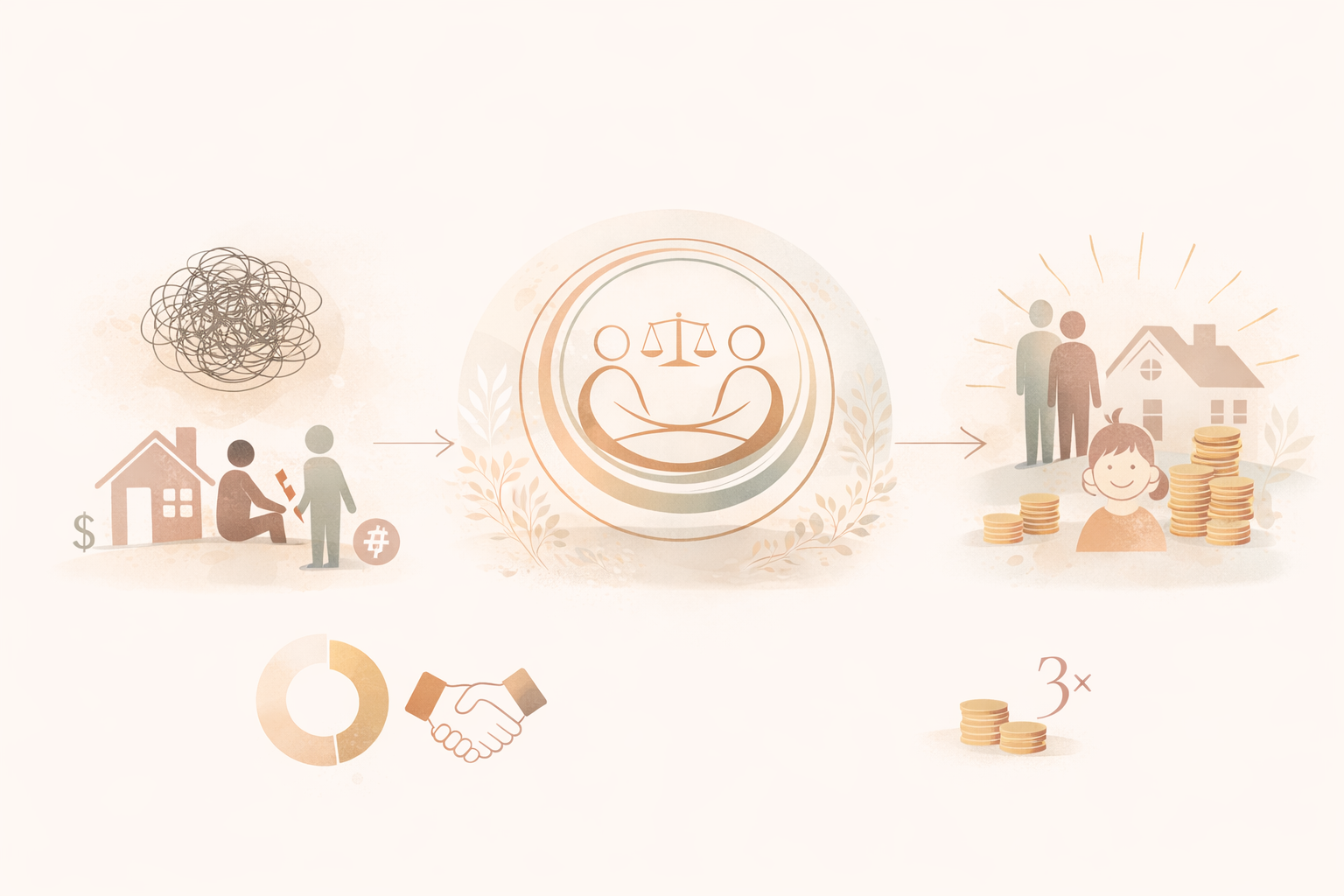
Family life is rarely straightforward. Relationships shift, circumstances change, and there are times when conversations that once felt natural become strained or impossible. When that happens, many people feel stuck — wanting things to settle but unsure of how to begin.
Mediation offers a structured, supported alternative to navigating these moments alone or through adversarial legal processes. It creates the conditions for honest, respectful conversation, guided by a trained neutral professional whose only role is to help both sides feel heard.
You do not need to have everything figured out before arriving. Mediation is not about perfection or preparation — it is about creating a steady space where thinking can happen clearly, options can be explored honestly, and decisions can be made thoughtfully.
Many people describe mediation as the first time they felt genuinely listened to during a difficult family period. That shift — from talking at each other to talking with each other — is often where things begin to change.
Mediation is confidential, voluntary, and structured around your family's specific needs. There is no judgment, no predetermined outcome, and no pressure to resolve everything in a single session.
When people feel supported in the right environment, the path forward becomes clearer than it initially appeared.
There is an important difference between having a difficult conversation and having a guided one. Professional mediation does not simply provide a room — it provides structure, safety, and the expertise to help conversations move in a constructive direction.
Unlike court proceedings, mediation is designed to reduce conflict rather than escalate it. This is particularly important where ongoing co-parenting or family communication is involved.
Solutions shaped by the people they affect are more likely to be followed and sustained over time. A mediator guides — but families decide. That distinction matters greatly in practice.
When children are part of the picture, their needs remain at the centre of every conversation. Mediation encourages parents to think carefully about stability, routine, and emotional security.
Financial matters, housing decisions, and parenting arrangements can feel overwhelming. A structured process breaks these conversations into manageable stages, making complexity more navigable.
Even when people strongly disagree, mediation upholds the expectation of mutual respect. This environment often allows conversations to take on a tone that was no longer possible at home.
There is no obligation to resolve everything at once. Mediation moves at the pace that suits the family, and sessions can be spread across time as needs evolve.
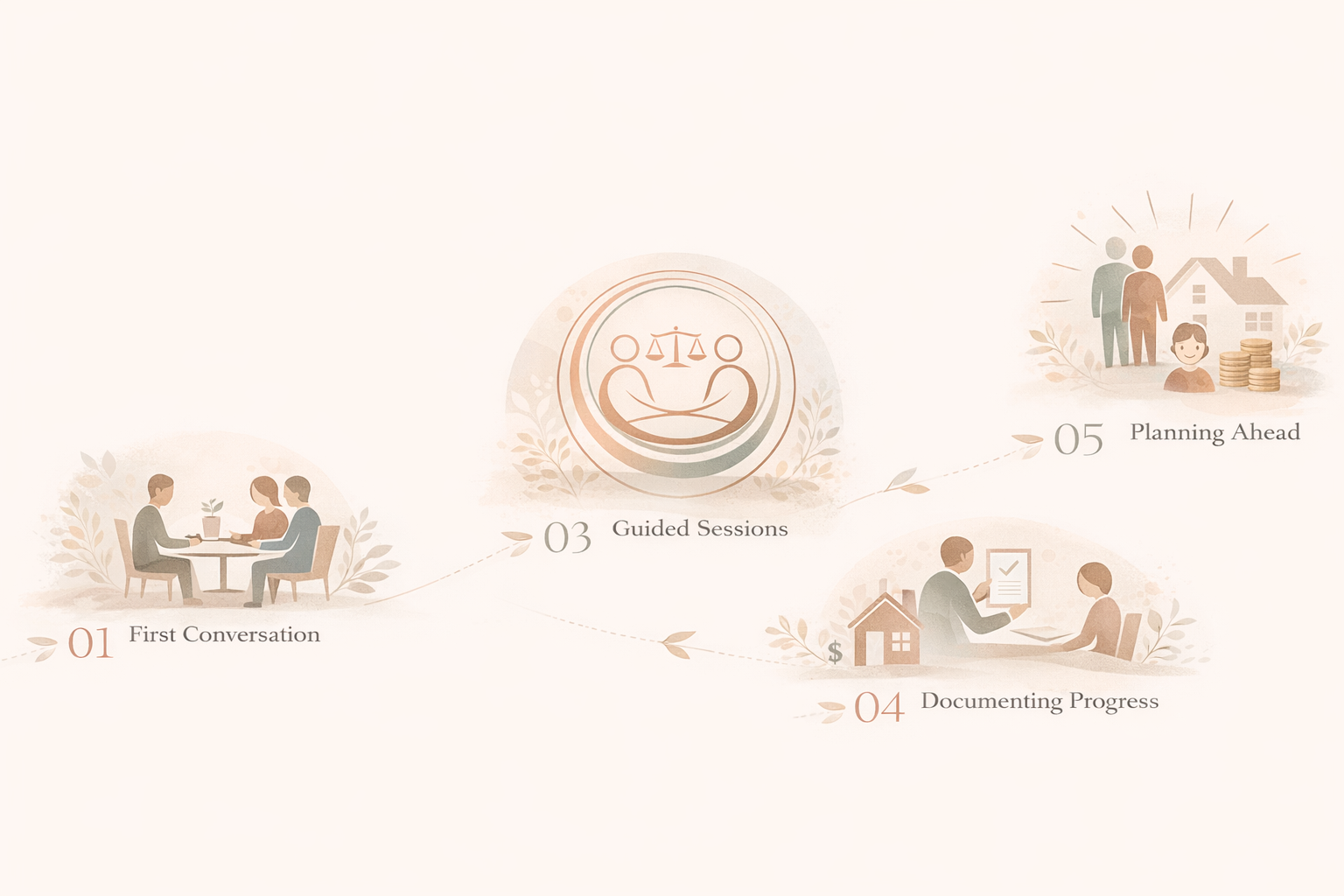
Understanding the steps involved can make mediation feel less unfamiliar. The process is thoughtfully structured to ensure that everyone involved feels safe, informed, and able to participate fully at every stage.
Everything begins with an informal introductory call. This is an opportunity to understand the situation, answer any questions about the process, and explore whether mediation is the right path at this time. There is no obligation and no pressure — it is simply a conversation about what is possible.
If mediation is agreed upon, both parties are helped to prepare for the first session. Ground rules are established, expectations are set clearly, and the role of the mediator is explained. This preparation ensures that the sessions begin in a grounded and balanced way, with both participants understanding what the process is designed to achieve.
During sessions, both parties have the opportunity to speak openly about what matters most to them. The mediator facilitates the conversation — ensuring both sides are heard, keeping discussions calm and productive, and gradually steering attention from past disagreement toward future possibilities. Progress is steady, and sessions are paced according to the family's individual needs.
When agreements begin to form, they are recorded in clear, straightforward language. These notes ensure that everyone has a shared understanding of what has been decided and how plans will work in practice. Where appropriate, independent legal advice can be sought, and agreements may subsequently be formalised through the courts.
The final stage is about ensuring families leave with a clear sense of what comes next. Mediation aims not only to resolve immediate concerns, but to establish communication frameworks that continue to serve families well over time. Many people find that the process itself changes how they approach conversations going forward.
Mediation is suitable for a wide range of family situations. It is not limited to separating couples — it can help any family members who need a structured, neutral space to work through important decisions together.
However, it is not appropriate for every circumstance. Where there are concerns about domestic abuse, coercion, or intimidation, alternative forms of support or legal avenues may be more appropriate. Safety is always the first consideration.
Both parties are willing, at least in principle, to participate. Mediation does not require agreement from the outset — only a shared willingness to sit in the same room and begin talking.
The process is designed to work with disagreement. It does not need people to be on good terms; it simply needs people to be willing to try.
Each situation is assessed individually during the initial conversation. There is no expectation that mediation is right for everyone, and honest guidance will always be offered where another path may be more appropriate.
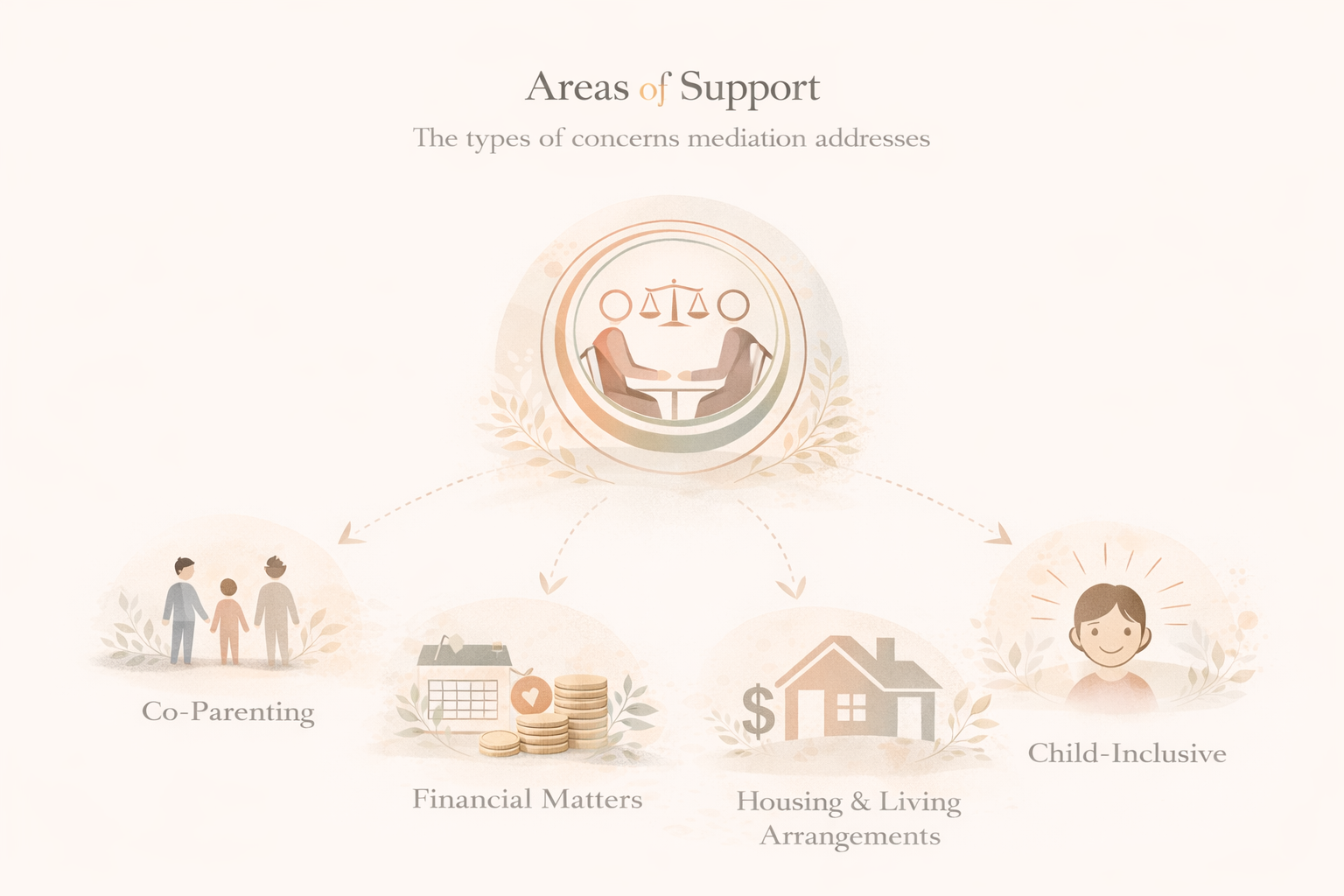
When a relationship comes to an end, there are plenty of practical considerations that need to be made about the future. Mediation allows a space where both individuals can address these concerns together. Conversations are respectful and all parties remain focused on practical solutions with the guidance of a neutral mediator. The idea is that the process allows couples to proceed with more understanding and less strife.
**Parenting Arrangements** When parents separate, questions often come up about how life will work for the children. Where will they live? How will time be shared between both parents? How will decisions about school, health, or activities be made? Mediation helps parents talk through these questions calmly, with the focus always on what will help the children feel secure and supported.
Where will the children live? How will time be shared? How will decisions about schooling, health, or activities be made? These are important questions, and mediation helps parents work through them thoughtfully, keeping the children's wellbeing at the centre.
Money and property are sensitive topics for many people, even at the best of times — and when your relationship is ending. There are likely to be questions about shared finances, responsibilities or what happens to the family home. “Mediation provides a safe space for these issues to be discussed in an open and thoughtful manner.” People can see their options together and move toward arrangements that seem fair and doable. This is also useful alongside other independent financial or legal advice too.
Family changes affect children deeply, but they are often not part of the conversations about what is happening. Child-inclusive mediation gently brings their perspective into the process. A trained professional may speak with the children in a careful and age-appropriate way, simply to understand how they are feeling and what matters to them. The goal is not to place decisions on the children, but to help parents hear their experiences and keep their wellbeing at the centre of the discussions.
Mediation isn’t only for people who have already decided to separate. Sometimes couples simply feel unsure about the future and need a calm space to talk things through. An early conversation can help people understand their options, express what they’re feeling, and look at possible ways forward. Even at this stage, mediation can reduce tension and bring a little more clarity during an uncertain time.
Some families include more than just parents and children. Grandparents, step-parents, or other relatives may also play an important role in a child’s life. When families change, it can be helpful to talk about how these relationships will continue and what each person’s role will be. Mediation gives families a space to have these conversations calmly and work out arrangements that recognise the different people who are part of the child’s support system.
Mediation is not a quick fix, and it does not make difficult feelings disappear. Family changes carry real emotional weight, and it is entirely natural to feel sadness, frustration, or uncertainty throughout the process.
What mediation does is change the environment in which those emotions are navigated. When conversations happen in a calmer, more supported space, it often becomes easier to think clearly, to hear what the other person is saying, and to make decisions that feel genuinely considered.
Progress in mediation is rarely linear. Some sessions feel more productive than others. Some conversations need to be revisited. This is normal, and the process is designed to allow for that kind of organic movement.
Many families who reach the end of mediation describe not just the practical agreements they have reached, but a shift in how they relate to each other. That longer-term change in communication is often one of the most lasting benefits of the process.
"Instead of preparing arguments, people begin to explore possibilities. Instead of focusing on past disagreements, attention slowly shifts toward the future."
Barker Mediation
Mediation does not conclude the moment sessions end. What has been agreed needs to be understood, maintained, and adapted as family life continues to evolve. The following principles help ensure that progress made in mediation is sustained over time.
Agreements reached in mediation are written in plain, clear language so that all parties understand exactly what has been decided and what is expected going forward.
Where appropriate, mediated agreements can be incorporated into legally binding arrangements through the courts. Independent legal advice is always recommended as part of this process.
Family life changes. Agreements made in mediation are designed to be practical and adaptable, so that they continue to work as children grow older or circumstances shift.
One of the lasting benefits of mediation is the communication skills and habits it can foster. Many families find they are better equipped to handle future conversations having been through the process.

These reflections represent the kinds of experiences families often describe after mediation — the human reality of what it feels like to move from stuck to moving forward.
We came in barely able to speak to each other without it turning into an argument. By the third session, we were actually listening. We still disagree on some things, but the children have a routine now, and that matters more than anything.
I was terrified before the first session. I thought it would just be another confrontation. It wasn't. The mediator was calm and fair, and for the first time I felt like my concerns were actually being considered.
We weren't sure mediation was right for us. We'd been stuck on the same issues for months. But having a structured space to talk — really talk — made it possible to see a way through that we genuinely both felt was fair.
Effective mediation is grounded in a clear set of values. These are not simply professional principles — they are the beliefs that shape every conversation and every decision made within the process.
When people feel genuinely listened to, the quality and tone of conversation changes. Creating space for both parties to speak — and to be heard — is the foundation of everything that follows in mediation.
Disagreement does not require disrespect. The mediation environment is maintained as a place where both parties can engage honestly without the conversation becoming destructive or harmful.
The role of a mediator is to guide, not to decide. Families who shape their own solutions are more likely to feel committed to them — and more capable of adapting them as circumstances change.
When children are involved, their wellbeing — their sense of security, their relationships with both parents, their need for stability — remains at the heart of every conversation.
Mediation is not right for every situation, and that is always communicated honestly. Where another path would serve a family better, that guidance is offered without hesitation.

Starting the process does not require certainty. It simply requires a willingness to explore whether mediation might be helpful. The following outlines what the early stages look like for most families.
Family change is never easy. The weight of important decisions — about children, finances, homes, and the future — can feel enormous when carried alone or navigated through conflict.
But when families are given the right environment to have those conversations — calmly, honestly, and with proper support — solutions often emerge that would not have seemed possible at the start.
Mediation is not about erasing difficulty. It is about finding a way through it — thoughtfully, with respect, and with the people who matter most kept at the centre of every decision.
The path forward becomes clearer when people feel heard and supported.