How Much Attic Insulation an Oregon Home Actually Needs

How Much Attic Insulation an Oregon Home Actually Needs

Most Oregon homes are under-insulated, and their owners have no idea. The Insulation Institute estimates that 90 percent of US homes fall short of current standards, and many Oregon houses built before 1980 sit at R-11 or less in the attic, roughly a quarter of what the state's code now calls for. That gap is not abstract. It is the reason a furnace runs constantly through a long Oregon winter and the heating bill climbs every year. Knowing how much attic insulation an Oregon home actually needs, and how to tell what is already up there, turns a vague worry into a fixable number. Klaus Roofing Systems of Oregon handles attic efficiency work as an Attic Systems dealer across the Willamette Valley and beyond.

The question has a real answer, grounded in Oregon code, the physics of a heated house, and a look in the attic that any homeowner can start on their own.
Most homes fall short

The Insulation Institute estimates 90 percent of US homes are under-insulated, and many Oregon homes built before 1980 sit at R-11 or less, about a quarter of current code.

Warm air rises out the roof

In an under-insulated attic, the heat you pay for climbs through the ceiling all winter, which is why the attic is the highest-return place to add insulation in most homes.

Oregon rebates the upgrade

Energy Trust of Oregon pays roughly $0.75 to $2.25 per square foot on qualifying attic insulation, often covering 15 to 30 percent of the project cost for eligible utilities.

What Oregon code actually requires

Oregon's Residential Specialty Code, the 2023 ORSC that took effect April 1, 2024, sets among the more demanding attic standards in the country. It calls for R-49 in flat ceilings and R-30 in vaulted ceilings, along with a 4 ACH50 blower door air-tightness target for new construction. Existing homes are not required to retrofit up to that level, but R-49 is where most Oregon homeowners get the strongest return, because it is matched to the state's long heating season. Thinking of R-49 as the target, rather than as an optional upgrade, is the honest way to frame a retrofit.

How to tell what you already have

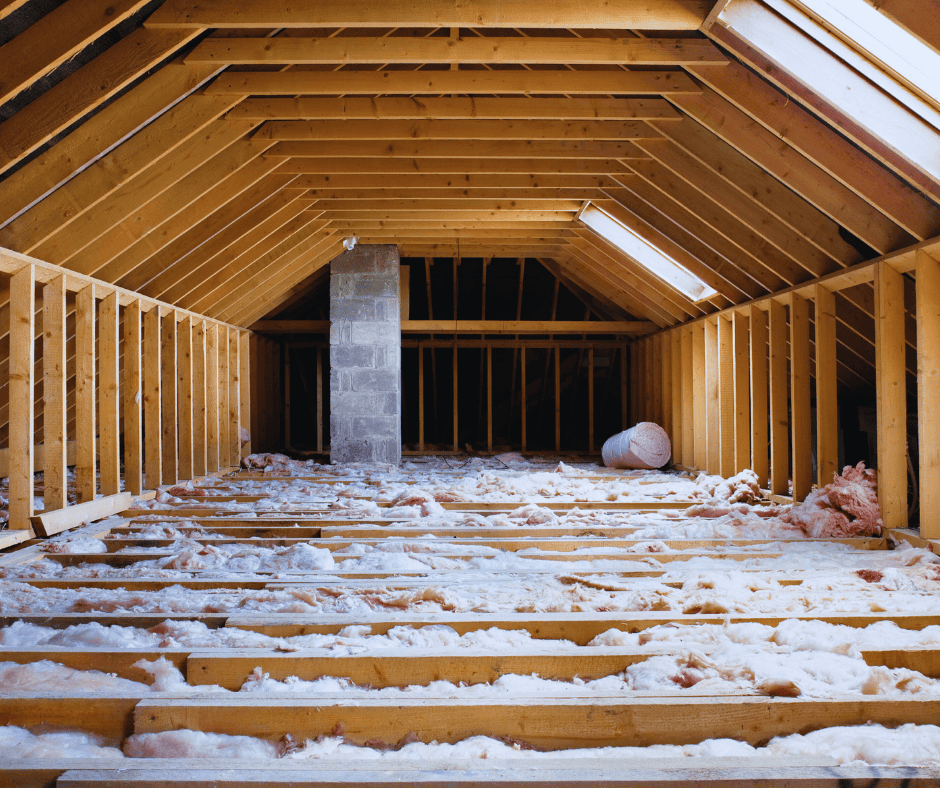
A homeowner can estimate existing insulation by looking. Loose-fill insulation at about 12 inches of depth is roughly R-38 to R-49. Six inches or less is around R-19 or below. The simplest test of all: if the ceiling joists are visible sticking up above the insulation, the attic is under-insulated by any modern standard. Insulation also settles and compresses over the years, quietly losing R-value even where the depth once looked adequate. That visual check is where the decision starts, and it is why a real assessment measures depth in several spots rather than assuming.

Why the attic is where the money leaks

The reason attic insulation matters so much comes down to a simple fact. Warm air rises. In an under-insulated attic, the heat a household pays to produce climbs straight through the ceiling and out through the roof, hour after hour, all winter, while cold outside air pulls in through the same gaps. This stack effect runs every day of Oregon's heating season, which is why the attic is the single highest-return place to add insulation in most homes. The visible symptoms are cold ceilings, uneven room temperatures, and a furnace that never rests. The invisible one is the utility bill. ENERGY STAR estimates that properly insulating and sealing the attic saves an average of about 15 percent on heating and cooling, and in Oregon's long winter that adds up faster than in milder places.

Air sealing comes first

Insulation slows heat moving through surfaces, but it does not stop air leaking through gaps. Before or alongside adding insulation, sealing the openings where conditioned air escapes, around attic hatches, top plates, can-light covers, plumbing and electrical penetrations, and duct chases, is what makes the insulation perform. Adding depth over a leaky attic floor is like putting on a heavier coat while leaving it unzipped. Air sealing and insulation work together, and skipping the sealing step is a common way a retrofit underdelivers.

The Energy Trust of Oregon rebate that changes the math

Oregon homeowners have a real incentive that most do not use. Energy Trust of Oregon pays roughly $0.75 to $2.25 per square foot on qualifying attic insulation retrofits, which often covers 15 to 30 percent of the project cost, for customers of PGE, Pacific Power, NW Natural, Cascade Natural Gas, and Avista. To qualify, existing insulation generally has to be R-18 or less, and the upgrade has to reach at least R-38 for a single-family home or R-30 for a manufactured home. The application is typically due within 60 days of installation and takes several weeks to process. Eligibility depends on the utility and the existing R-value, so confirming the current terms before counting on a specific amount is worth doing. Homeowners exploring a retrofit can see how Klaus Roofing Systems of Oregon approaches attic efficiency from assessment through installation.

A clear read on what your attic needs

Klaus Roofing Systems of Oregon is a family-owned and locally operated contractor, licensed in Oregon under Contractor ID 231578, with OSHA-compliant crews and an Attic Systems dealer authorization. Attic work starts with a free in-person assessment that measures existing depth and R-value, checks for air leakage, and puts a written plan and price on paper before anything is installed. The company installs cellulose, rigid foam, and spray foam, handles air sealing and duct sealing, documents before and after depth, and offers financing. There is no federal roofing or attic tax credit to rely on for 2026, since the federal 25C credit expired at the end of 2025, so the honest levers are the Energy Trust rebate for qualifying homes and the utility savings over time.

Finding out how much attic insulation an Oregon home needs starts with a look and a measurement, not a guess. Homeowners can call Klaus Roofing Systems of Oregon at 541-275-2202 for a free in-person attic assessment.

Redirect to:


Redirect to:


Frequently Asked Questions


Oregon's code sets attic minimums at R-49 for flat ceilings and R-30 for vaulted ceilings. Existing homes are not required to retrofit to that level, but R-49 is where most Oregon homeowners get the strongest energy return given the long heating season. Klaus measures your existing R-value during a free in-person assessment.
Look in the attic. Loose-fill at about 12 inches of depth is roughly R-38 to R-49, and 6 inches or less is around R-19 or below. If the ceiling joists are visible above the insulation, the attic is under-insulated. Insulation also settles over time, losing R-value even where the depth once looked fine.
Energy Trust of Oregon pays roughly $0.75 to $2.25 per square foot on qualifying retrofits for customers of PGE, Pacific Power, NW Natural, Cascade Natural Gas, and Avista, often covering 15 to 30 percent of the cost. Existing insulation generally must be R-18 or less and the upgrade at least R-38 for a single-family home. Confirm current terms before counting on a specific amount.