| Overview |  |
Copyright © 2016 - 2026 SigScale Global Inc.
Version: 3.4.54
This application implements an Online Charging System (OCS).
This application implements functions used by communications service providers (CSP) for authorization and charging of prepaid services. It is built to TM Forum standards with Open APIs for management of product, service and balance. A web components front end is also provided as a progressive web app (PWA) for standalone use.
SigScale OCS provides the following high level functions.
An internal catalog of Product Offerings and Prices is provided which may be synched from an external master catalog (TMF620) where available. Any number of offers may be created, with simple or complex rating, using multiple Prices matched to appropriate service usage. Tariff tables may be used to rate by origination and/or destination address prefix as well as visited network (VPLMN MCC-MNC). Product Offerings may be bundled to create Voice, Data and Messaging offers.
An internal inventory of subscribed Products is maintained which may be synched from an external master inventory (TMF637) where available. Account Balance Buckets are associated with a Product instance (subscription) and may be shared by associated Services (devices).
An internal Service Inventory contains the subscriber identifiers used to match reported service usage with a Product. It may be synched with an external master inventory (TMF638).
Authentication, authorization and accounting (AAA) functions are the foundation to commercial operations of a CSP. In a 3GPP OCS use case authentication will have already been ccomplished before a DIAMETER Ro/Gy Credit Control Request (CCR) is received by the OCS. Authorization is performed by the OCS based on the application of prevailing ratees and available account balance. Accounting is perormed by reserving and charging against account balance, in real time, during service usage.
Authentication is optionally provided. Subscriber credentials (i.e. password or K/OPc) may be stored internally with authentication performed over DIAMETER/RADIUS using EAP methods (AKA/AKA', PWD, TTLS).
An Online Charging System (OCS) performs real-time charging for services. A Converged Charging System (CCS) combines online (prepaid) and offline (postpaid) charging in one 5G Core function. An OCS/CCS authorizes subscribers' sessions subject to available credit on account and decrements account balance as services are consumed. When a subscriber's account balance is depleted authorization may be withdrawn and ongoing session(s) terminated.
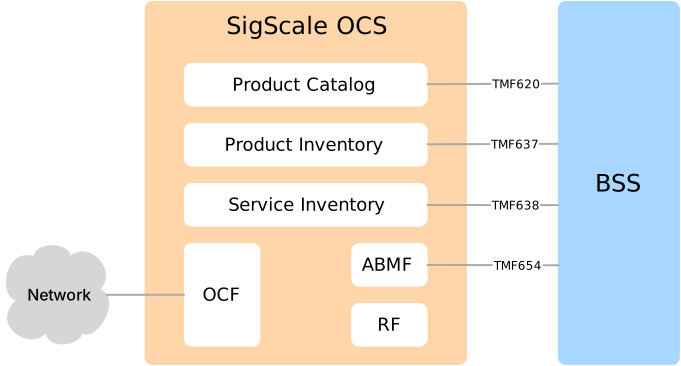
The OCS/CCS includes control plane interfaces to core networks but also integrates with Business Support Systems (BSS) which manage commercial operations and customer management. SigScale OCS is designed and built to make this integration as frictionless as possible. The diagram below represents a possible solution architecture.
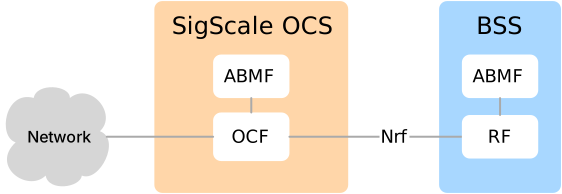
A 3GPP OCS/CCS may be decomposed into OCF/CHF, RF and ABMF (3GPP TS 32.296). A protocol for the Re interface, based on DIAMETER, was partially specified however SigScale has progressed this work by aligning with the 5GC SBI for Nch and created the Nrf REST API described below.
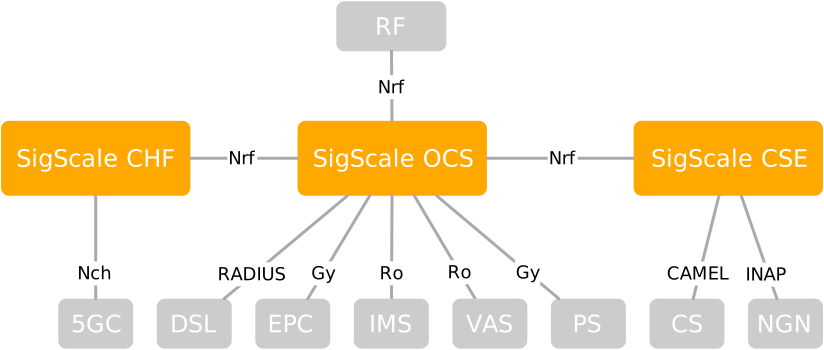
The network facing protocols (DIAMETER, RADIUS) are handled by an Online Charging Function (OCF). In 5G Core this is the CHF.
The Rating Function (RF) provided in SigScale OCS is driven entirely by the Product Offering Prices (POP) in the catalog. The RF determines which of the POPs apply and determines a tariff rate to apply for the requested service usage. In class B operation the RF and ABMF are colocated and the response is for the combined operation. In class A operation only the tariff rate to be applied is retruned and the OCF/CHF shall interact with the ABMF directly. The class of operation may be decided by the RF dynamically, a mix of class A and B may be used.
The Account Balance Management Function (ABMF) supports reservation, debit and refund in monetary, byte, time and event units across multiple discrete Buckets. Each Bucket has it's own lifecycle period wth charging done across Buckets with a first to expire priority. External systems may use the TMF654 API to check accumulated balance, recgharge, etc..
The Policy and Charging Rules Function (PCRF) is included which produces a DIAMETER Gx application service on the same ports as the Ro application (default 3868). Both static and dynamic Policy Rules installation on the Policy Enformenet Control Function (PCEF) is supported. Any number of Policy Tables may be created, containing any number of Policy Rules. A Product Offering may have a Policy Table associated with it, allowing QoS to be defined at the Product Offering level and automatically applied to subscribers. Rules may be managed with the PWA (GUI) or TMF639 API.
Support for 3GPP CAMEL (Customized Applications for Mobile network Enhanced Logic) protocol is available through an integration with SigScale CSE which provides a CAMEL Service Envirionment (CSE). The interface between CSE and OCS is the Nrf API described in the REST section below.
This application conforms to 3GPP specifications for the interfaces, protocols and procedures of the OCS, PCRF and 3GPP AAA Server functions in the reference architecture. Supported interfaces include DIAMETER Ro/Gy, RADIUS and Nrf for OCS, Gx for PCRF and SWm/STa/SWx/S6b for AAA Server.
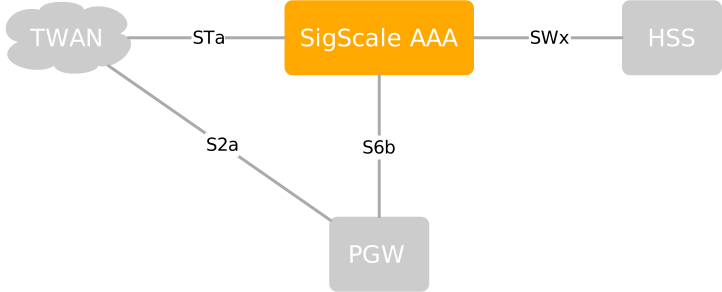
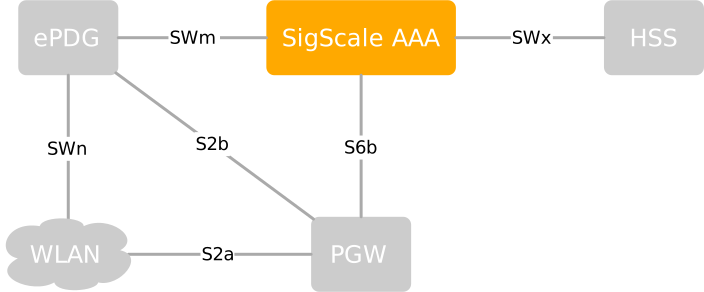
Non-3GPP access use cases are supported with the 3GPP AAA Server function which builds on the base AAA function and includes the 3GPP reference architecture interfaces SWm, STa, S6b and SWx. The SIM's AKA credentials (K, OPc) may be stored internally, for testing or standalone deployments. In normal operation the DIAMETER SWx application is used to retrieve authentication vectors from a Home Subscriber Server (HSS).

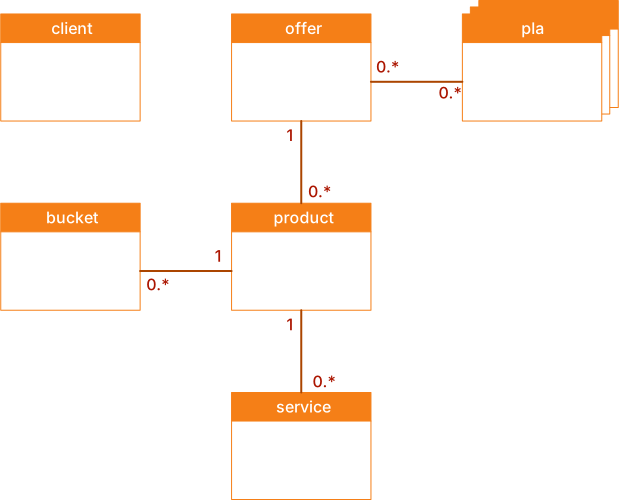
The table schema is a faithful mapping of TM Forum's Information Model SID. The product table represents Product Inventory. A row in this table represents a subscription and is associated to zero or one row of the offer table which represents the Product Offering collection. A row in the offer table may be associated with zero or more Pricing Logic Algorithms (PLA) implemented with prefix matching tables. A product table row may be associated with zero or more Balance Buckets as represented by the bucket table. The Service Inventory is represented by the service table. A product table row may be associated with zero or many service table rows while a service table row may be associated with at most one product table row.
| Table Name | Description |
|---|---|
| offer | Product Catalog |
| product | Product Inventory |
| service | Service Inventory |
| bucket | Balance Buckets |
| pla | Pricing Logic Algorithms (Rate Tables) |
| client | RADIUS/DIAMETER Clients |
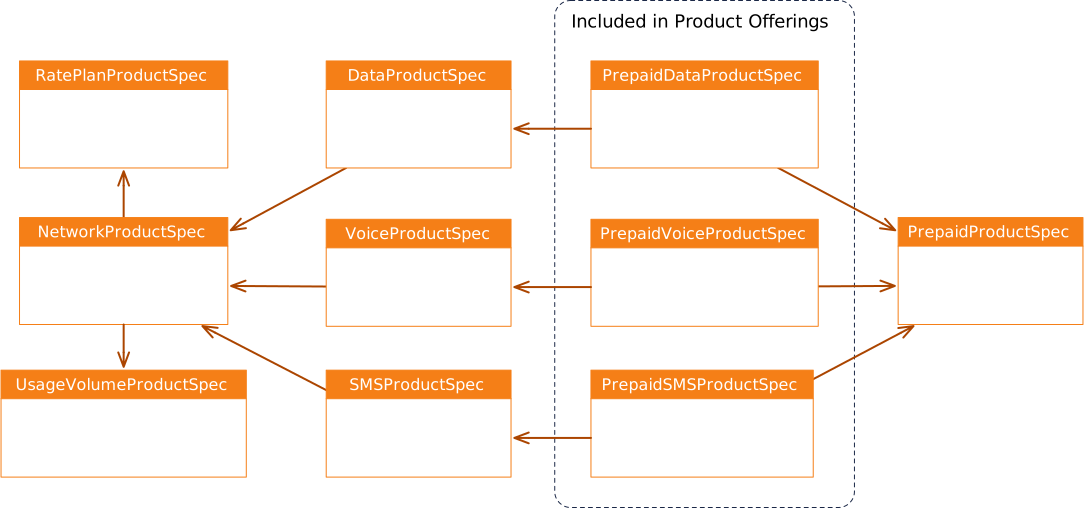
Rating and charging is controled by Characteristic values
chosen when creating Product Offerings and
Product Offering Prices. The Characteristics are
defined in Product Specifications available with the
Product Catalog API (TMF620)
(/productCatalogManagement/v2/productSpecification/). The diagram
below depicts the dependency relationships. An atomic
Product Offering will include one of the Prepaid
Product Specifications.
Before starting the application for the first time, mnesia should be initialized. Create a schema and start mnesia on all nodes where the application ocs application will run.
The following command will initialize ocs on the current node and create a default REST user "admin" with password "admin".
e.g : (ocs-vances@rt)1> ocs_app:install().
{ok,[httpd_group,httpd_user,bucket,offer,pla,product,service,client]}
To use the mod_auth module for authentication
users are created in the mnesia tables it uses.
All users will be added to groups specified in require_group
option in inets httpd confifuration.
e.g :
	1> ocs:add_user("john", "g2k7hyeh6qa", "en").
	{ok,{1501829429047,149}}
	2> ocs:add_user("bss", "nfc9xgp32xha", "en").
	{ok,{1501829458220,157}}
The web UI also allows you to create users, making the above step unecessary.
The OCS application will start RADIUS & DIAMETER servers for authentication and accounting on the configured ports. The inets application may be started to provide a REST API and web user interface (UI).
One or more diameter services are configured to enable peering with
DIAMETER clients or Routing Agents (DRA).
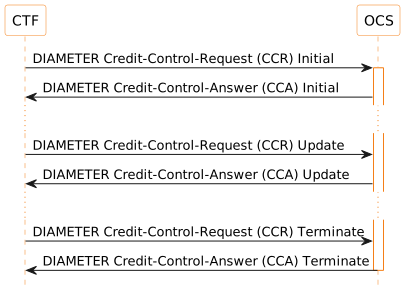
A typical prepaid charging message sequence across the Ro or Gy interface is depicted below:
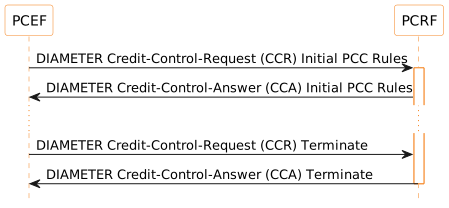
A typical policy and charging control (PCC) message sequence across the Gx interface is depicted below:
A typical non-3GPP access message sequence across the SWm and SWx interfaces is depicted below:

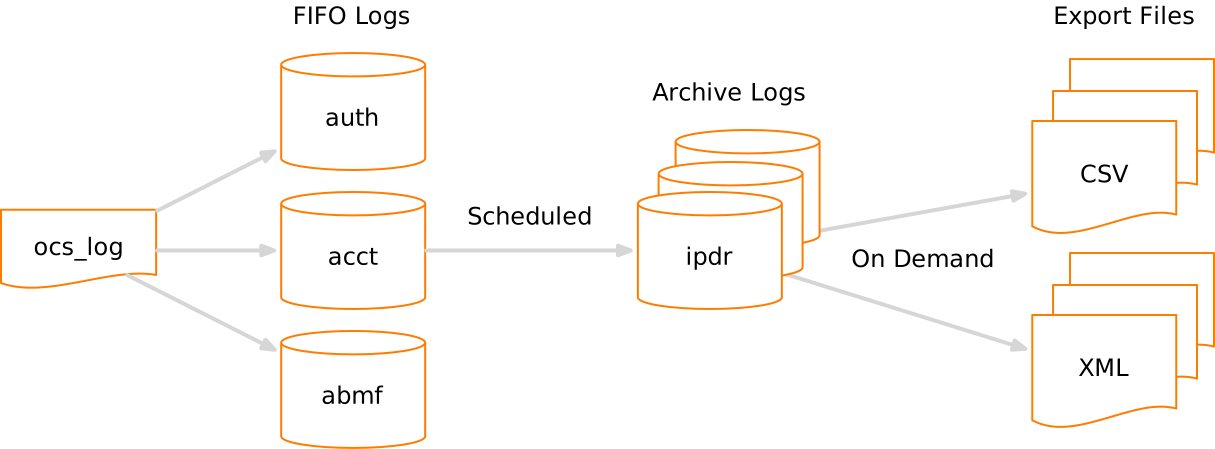
Every detail of each DIAMETER/RADIUS transaction is logged to disk.
Event details are logged to fixed size FIFO logs consisting of a configurable
number, and size, of internally formatted files. Events are written to archive
log files on a scheduled basis (default daily). These internally formatted
archive logs may be exported on demand to a supported file format (e.g. CSV).
A shell script is provided (bin/export_ipdr) for this purpose.
See acct_log_dir, acct_log_files, acct_log_rotate, acct_log_rotate_time,
acct_log_size, auth_log_dir, auth_log_files, auth_log_size, ipdr_log_dir,
and export_dir in the Configuration section below.
Optionally DIAMETER/RADIUS transactions may be shipped to LogStash with the http input plugin.

See elastic_shipper in the Configuration section below.
The ocs application provides RESTful APIs built on the HTTP protocol and using JSON data encoding.
The following industry standard TM Forum Open APIs are used:| Number | TM Forum Open API | Download | Browse |
|---|---|---|---|
| TMF620 | Product Catalog Management |

|

|
| TMF637 | Product Inventory Management |
|
|
| TMF633 | Service Catalog Management |
|
|
| TMF638 | Service Inventory Management |
|
|
| TMF634 | Resource Catalog Management |
|
|
| TMF639 | Resource Inventory Management |
|
|
| TMF654 | Prepay Balance Management |
|
|
| TMF635 | Usage Management |
|
|
| TMF632 | Party Management |
|
Sigscale's Nrf_Rating API follows the 3GPP's drafting rules for 5GC Service Based Interfaces (SBI) and is aligned with the Nchf SBI for the 5GC Charging Function (CHF). It is derived directly from the Re interface DIAMETER application (partially) specified in (3GPP TS 32.296).
| Name | Description | Download | Browse |
|---|---|---|---|
| Nrf | RF Rating Service |
|
|
The HTTP
methods used in this API include
GET,
HEAD,
POST,
PATCH and
DELETE.
| Type Name |
|---|
| application/json |
| application/json-patch+json |
| application/merge-patch+json |
Complex queries are supported using a filter attribute as described in issue
AP-832
of TM Forum
API Project.
[Note: TMF630 Part 6 provides an equivalent advanced query syntax using JSON Path, however this implementation peredates that by several years. A future version shall provide JSON Path syntax support.]
Example:
filter="[{usageCharacteristic.contains=[{name=nasIdentifier,value.like=[north-%]}]}]"
The right hand side (RHS) of the filter attribute should be enclosed
in double quotes (""). Query values seperated by a comma (,) and treated as AND.
A complex value should be enclosed in {}.
| Operation | Description | LHS Data Type | RHS Data Type |
|---|---|---|---|
| .exact OR = | Equals (Case-sensitive) | String, Number, Date, Boolean | String, Number, Date, Boolean |
| .notexact OR <> | Not equal to (Case-sensitive) | String, Number, Date, Boolean | String, Number, Date, Boolean |
| .like | Match the patterns in the argument array, where "%" matches zero or more characters. | String | Array of String |
| .contains | Match LHS elements with RHS | Collection/Array | Array of String |
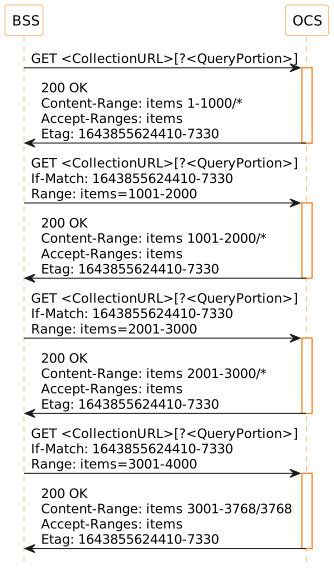
GET operation on a REST Collection, with or without a query
portion, could result in a huge array of Items. To prevent
overwhelming the client or server pagination is used. A maximum limit
on the number of items in a single response (page) is enforced (default
1000). The Content-Range header
(RFC7233)
shall indicate the range of the response and the total size (if available):
Content-Range: items 1-1000/3768
Accept-Ranges: items
Etag: 1643855624410-7330
The
Etag header provides a reference to a process in the server which
holds a result buffer and continuation pointer. This process will be
removed after an idle timeout (default 1m). A series of paginated GET
requests MUST include an If-Match header, containing the Etag value
of the first response, and specify the next page with the Range header:
If-Match: 1643855624410-7330
Range: items=1001-2000
See rest_page_size and rest_page_timeout in the Configuration section
below.
Event notification is supported as described in TMF630 Notification Patterns. An external entity may subscribe an API endpoint to receive event notifications for any of the Open APIs. A query portion may be included to limit the scope of subscribed events. Each eligible event will be sent to the endpoint in an HTTP POST operation.

[Note: A subscription will be silently removed on the first encountered
error in sending a notification. The /hub collections may be
be queried to verify that a subscription still exists.]
SigScale OCS supports fault & performance management with the Simple Network Management Protocol (SNMP). A management information base (MIB) for the OCS application is provided as well as IETF standard MIBs and SigScale's versions of IETF draft MIBs.
| IETF | MIB Name |
|---|---|
| SIGSCALE-OCS-MIB | |
| draft-ietf-dime-diameter-base-protocol-mib | SIGSCALE-DIAMETER-BASE-PROTOCOL-MIB |
| draft-ietf-dime-diameter-cc-appl-mib | SIGSCALE-DIAMETER-CC-APPLICATION-MIB |
| RFC4669 | RADIUS-AUTH-SERVER-MIB |
| RFC4671 | RADIUS-ACC-SERVER-MIB |
The ocs application may be configured using the following application environment variables.
b specifies a Class B RF with a colocated account balance management function (ABMF). If this option is not defined Class A operation is assumed with local RF and ABMF where any Product Offering Price may specify a remote RF as a pricing logic algorithm (PLA).[{1, <<0:128>>}])AAA-Failure-Indicator in MAR on SWx:
{aaa_failure, boolean()}
(default: false)[{ocs,
[{radius,
[{auth,
[{{0,0,0,0}, 1812,
[{eap_method_prefer, pwd},
{eap_method_order, [pwd, ttls]}]}]},
{acct,
[{{0,0,0,0}, 1813, []}]}]},
{diameter,
[{acct,
[{{0,0,0,0}, 3868, []}]},
{auth,
[{{0,0,0,0}, 3869,
[{eap_method_prefer, aka},
{eap_method_order, [aka, akap, pwd]}]},
{{0,0,0,0}, 0,
[{connect,
[{raddr, {172,16,1,2}},
{rport, 3868}]}]}]}]},
{hss_realm, "epc.mnc001.mcc001.3gppnetwork.org"},
{min_reserve_octets, 5000000},
{min_reserve_seconds, 60},
{min_reserve_messages, 1},
{acct_log_rotate, 1440},
{acct_log_dir, "log/acct"},
{acct_log_files, 100},
{auth_log_dir, "log/auth"},
{auth_log_size, 10485760},
{auth_log_files, 100},
{ipdr_log_dir, "log/ipdr"},
{export_dir, "log/export"},
{rest_page_size, 1000},
{tls_key, "ssl/key.pem"},
{tls_cert, "ssl/cert.pem"},
{tls_cacert, "ssl/ca.pem"},
{oauth_audience, "account"},
{oauth_issuer, "sigscale"},
{oauth_key, ssl/sigscale.pem}]},
{radius,
[{sock_opts, [{recbuf, 131072}, {sndbuf, 131072}]}]},
{snmp,
[{agent,
[{config, [{dir, "snmp/conf"}]},
{db_dir, "snmp/db"}]}]},
{inets,
[{services,
[{httpd,
[{server_name, "ocs"},
{directory_index, ["index.html"]},
{directory, {"/",
[{auth_type, mnesia},
{auth_name, "ocs.sigscale.org"},
{require_group, ["staff"]}]}},
{transfer_disk_log, "/usr/lib/erlang/lib/ocs-3.4.54/log/http/transfer"},
{security_disk_log, "/usr/lib/erlang/lib/ocs-3.4.54/log/http/security"},
{error_disk_log, "/usr/lib/erlang/lib/ocs-3.4.54/log/http/error"},
{transfer_disk_log_size, {10485760, 10}},
{error_disk_log_size, {10485760, 10}},
{error_disk_log_size, {10485760, 10}},
{security_disk_log_size, {10485760, 10}},
{disk_log_format, internal},
{modules,
[mod_alias,
mod_auth,
mod_disk_log,
mod_responsecontrol,
mod_ocs_rest_accepted_content,
mod_ocs_rest_get,
mod_get,
mod_ocs_rest_head,
mod_ocs_rest_post,
mod_ocs_rest_patch,
mod_ocs_rest_delete]},
{port, 8080},
{socket_type, {essl,
[{certfile, "/etc/ssl/certs/ocs.pem"},
{keyfile, "/etc/ssl/private/ocs.pem"}]}},
{server_root, "/home/ocs"},
{alias, {"/doc", "/usr/lib/erlang/lib/ocs-3.4.54/doc"}},
{document_root, "/usr/lib/erlang/lib/ocs-3.4.54/priv/www"}]}]}]}].
Generated by EDoc