Process & Productivity Optimization
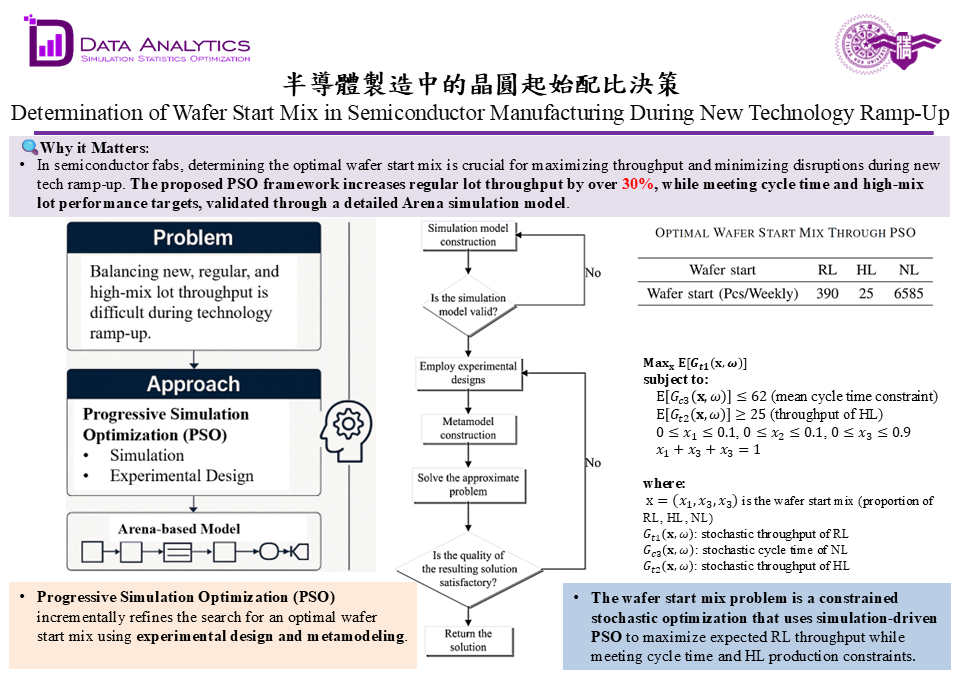
This represents the core technical competence of the laboratory, specifically focusing on mathematical modeling and simulation for complex processes within the semiconductor industry.
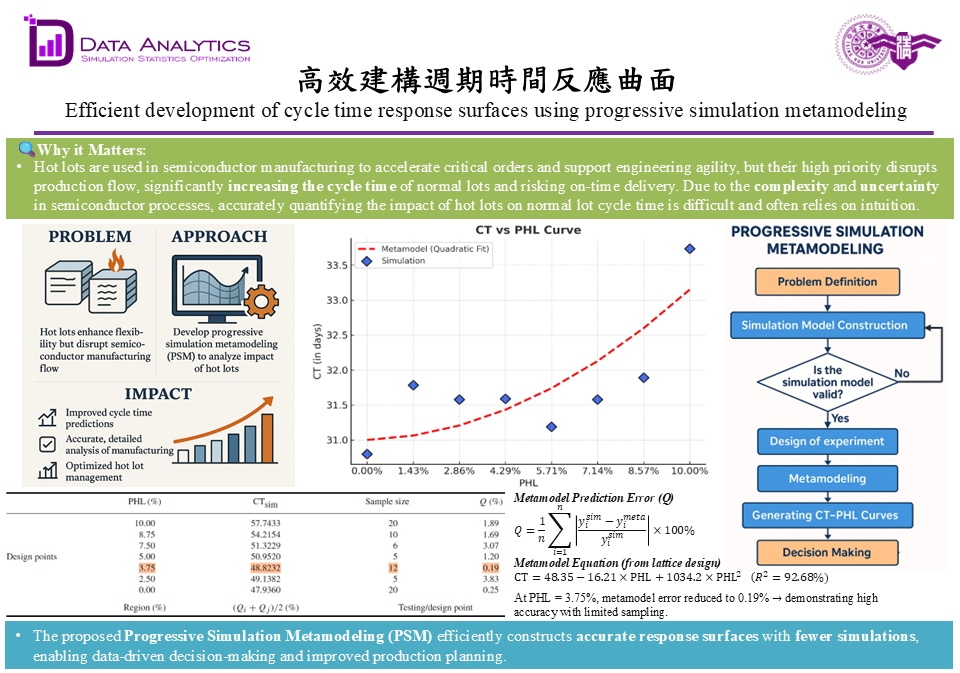
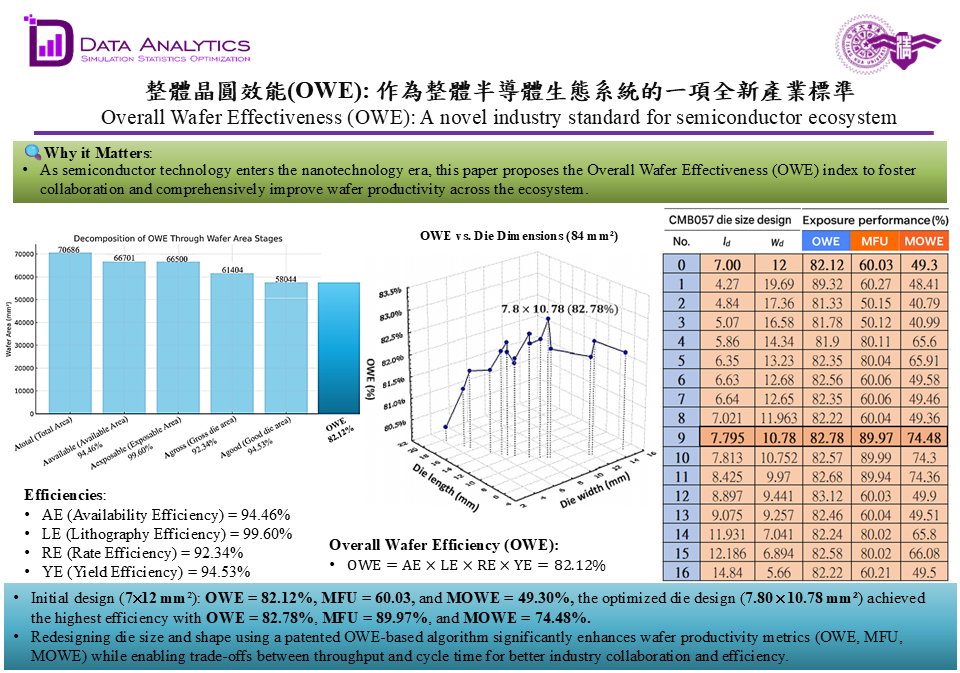
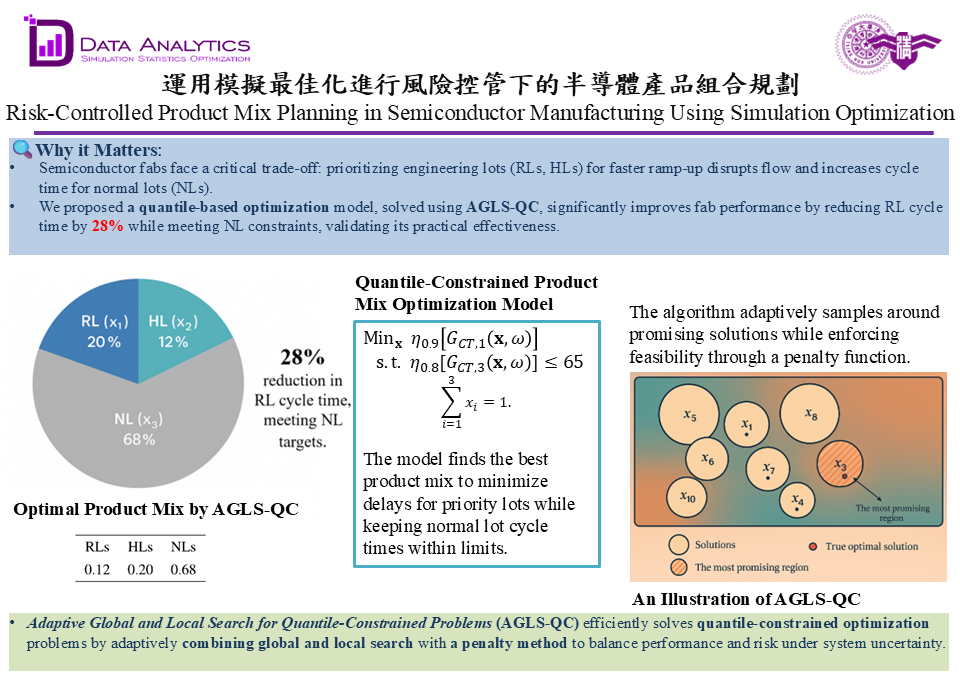
• Technical Highlights: The laboratory has developed a diverse range of advanced algorithms, such as Progressive Simulation Optimization (PSO), Progressive Simulation Metamodeling (PSM), and the Adaptive Genetic Algorithm with Local Search based on Quantile Constraints (AGLS-QC), to address internal factory scheduling and resource allocation challenges. Furthermore, a novel industry-standard metric, Overall Wafer Effectiveness (OWE), was proposed to evaluate productivity.
• Industry Solutions & Empirical Results:
◦ Capacity & Efficiency Enhancement: Successfully increased capacity for standard batches by over 30% during the technology ramp-up phase.
◦ Cycle Time Reduction: Reduced the cycle time for Hot Lots by 28% without compromising the on-time delivery rate of standard orders.
◦ Significant Yield Improvement: Increased the yield rate for In-Mold Decoration (IMD) processes from 10% to 87.5%.
• Technical Highlights: The laboratory has developed a diverse range of advanced algorithms, such as Progressive Simulation Optimization (PSO), Progressive Simulation Metamodeling (PSM), and the Adaptive Genetic Algorithm with Local Search based on Quantile Constraints (AGLS-QC), to address internal factory scheduling and resource allocation challenges. Furthermore, a novel industry-standard metric, Overall Wafer Effectiveness (OWE), was proposed to evaluate productivity.
• Industry Solutions & Empirical Results:
◦ Capacity & Efficiency Enhancement: Successfully increased capacity for standard batches by over 30% during the technology ramp-up phase.
◦ Cycle Time Reduction: Reduced the cycle time for Hot Lots by 28% without compromising the on-time delivery rate of standard orders.
◦ Significant Yield Improvement: Increased the yield rate for In-Mold Decoration (IMD) processes from 10% to 87.5%.
AI-Quality Control & PHM
The laboratory leverages machine learning, image processing, and unsupervised learning technologies to resolve the pain points of low efficiency and instability associated with traditional manual inspection.
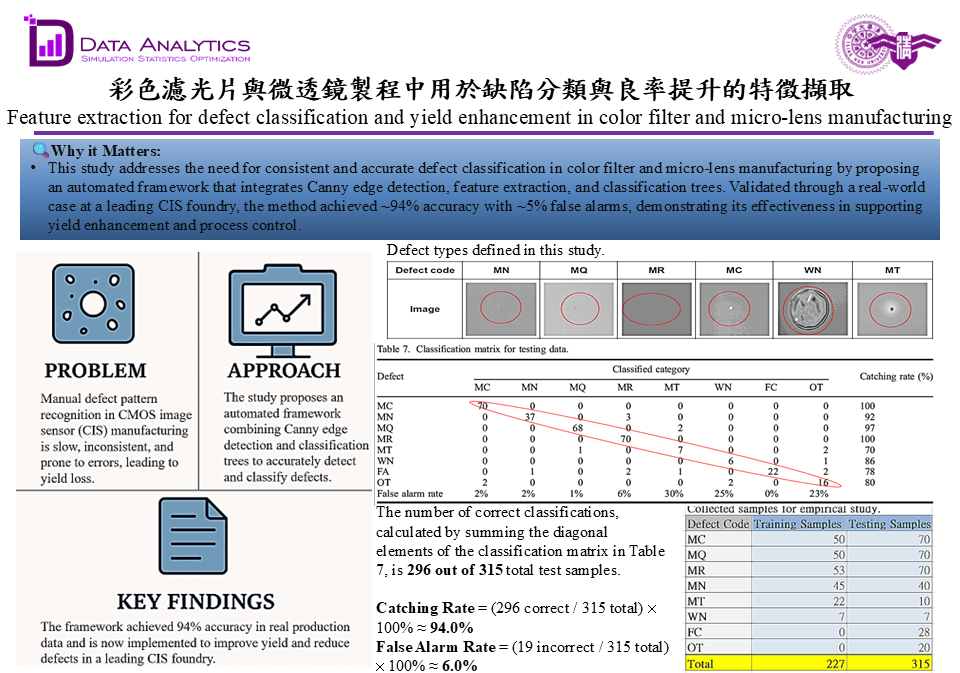
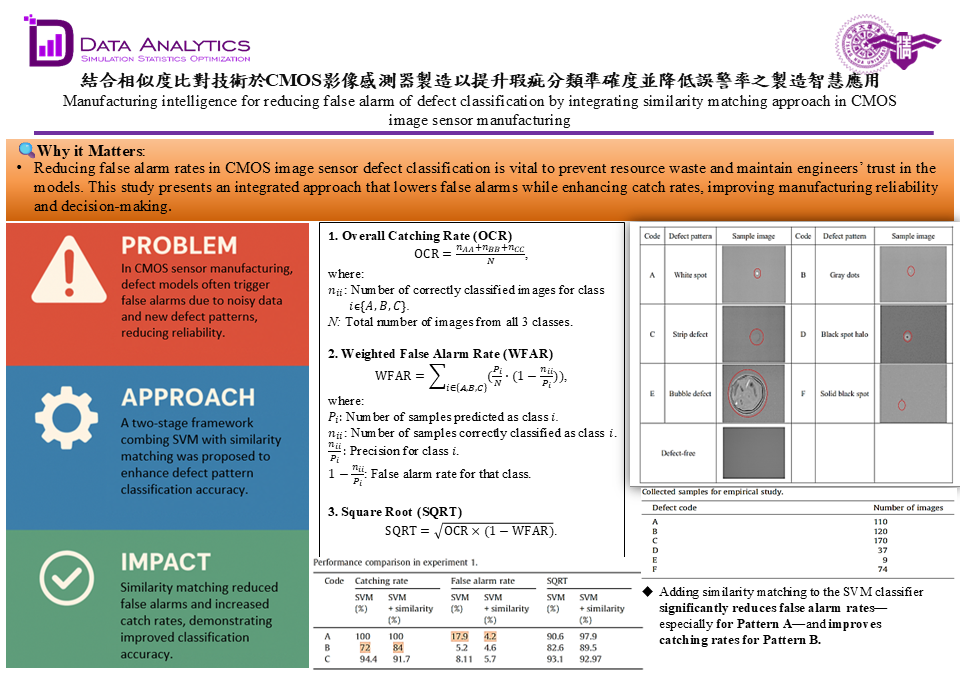
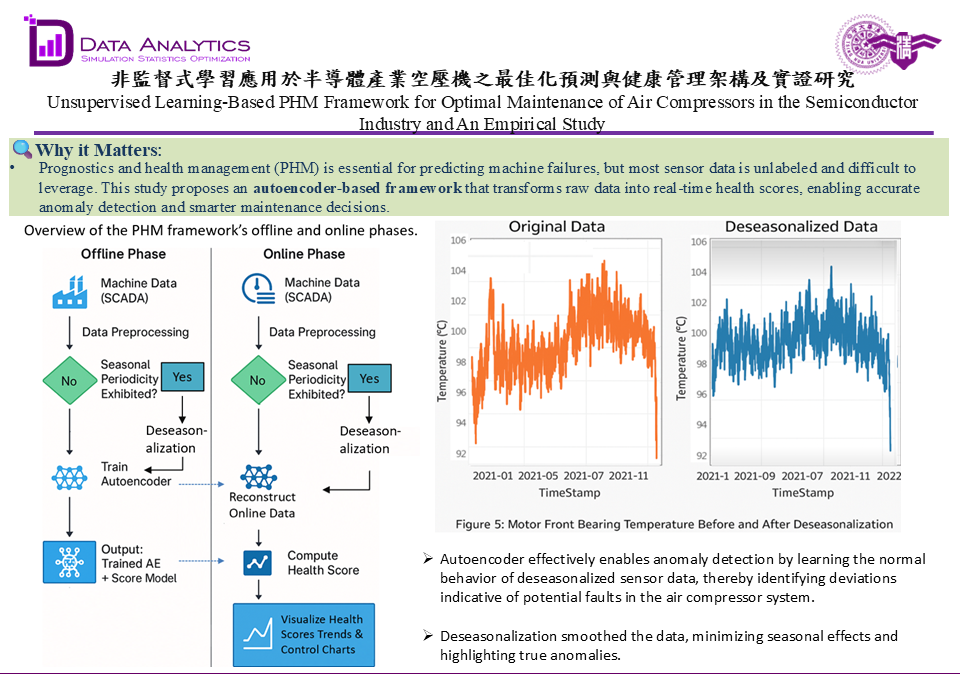
• Technical Highlights: The approach integrates Canny edge detection with classification trees, Support Vector Machines (SVM), and similarity matching techniques, as well as an unsupervised learning architecture based on Autoencoders.
• Industry Solutions & Empirical Results:
◦ Reduction of False Alarms: Significantly reduced the false alarm rate in defect detection for CMOS image sensor manufacturing, thereby enhancing decision-making reliability.
◦ Precise Defect Classification: The automated architecture achieved a 94% classification accuracy in color filter and microlens processes.
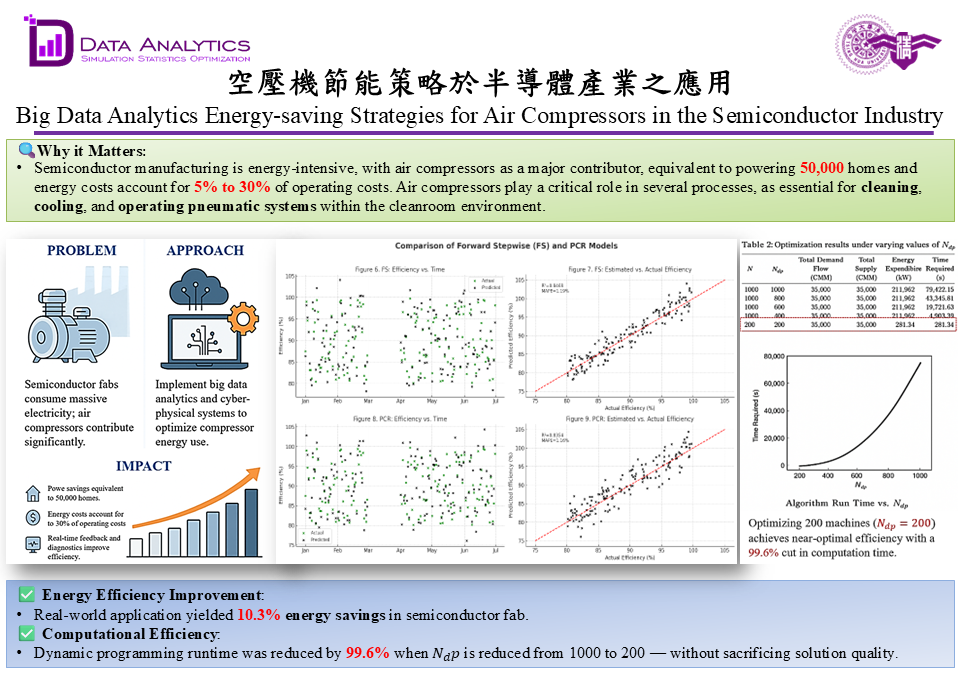
◦ Energy Saving & Predictive Maintenance: Assisted air compressor systems in achieving 10.3% energy savings and facilitated predictive maintenance by forecasting equipment failures in advance.
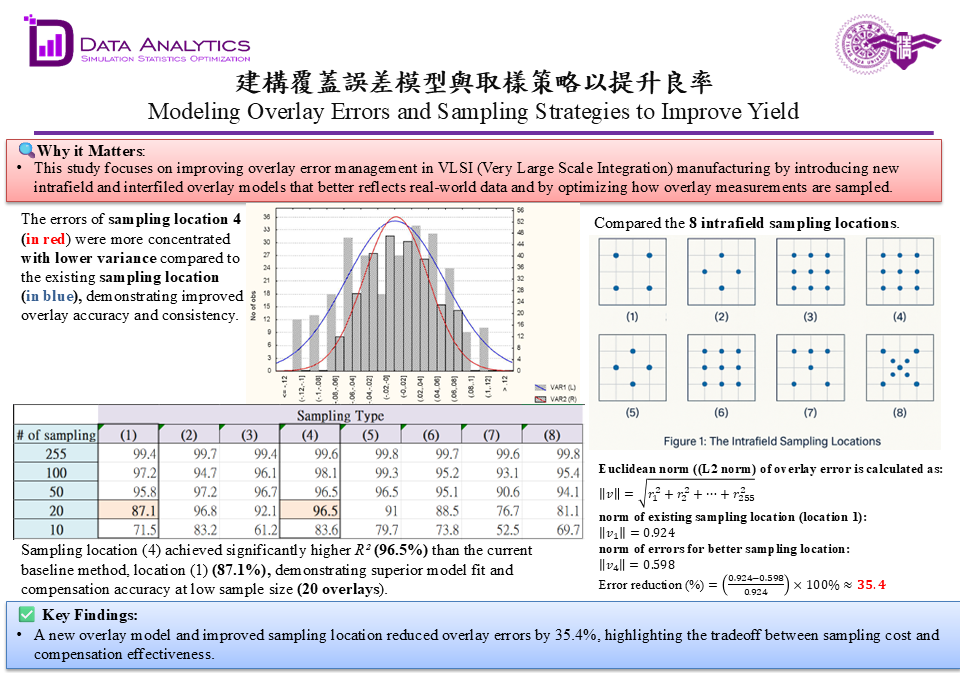
◦ Enhanced Measurement Precision: The overlay error model successfully reduced errors by 35.4%, lowering sampling costs while improving yield rates.
• Technical Highlights: The approach integrates Canny edge detection with classification trees, Support Vector Machines (SVM), and similarity matching techniques, as well as an unsupervised learning architecture based on Autoencoders.
• Industry Solutions & Empirical Results:
◦ Reduction of False Alarms: Significantly reduced the false alarm rate in defect detection for CMOS image sensor manufacturing, thereby enhancing decision-making reliability.
◦ Precise Defect Classification: The automated architecture achieved a 94% classification accuracy in color filter and microlens processes.
◦ Energy Saving & Predictive Maintenance: Assisted air compressor systems in achieving 10.3% energy savings and facilitated predictive maintenance by forecasting equipment failures in advance.
◦ Enhanced Measurement Precision: The overlay error model successfully reduced errors by 35.4%, lowering sampling costs while improving yield rates.
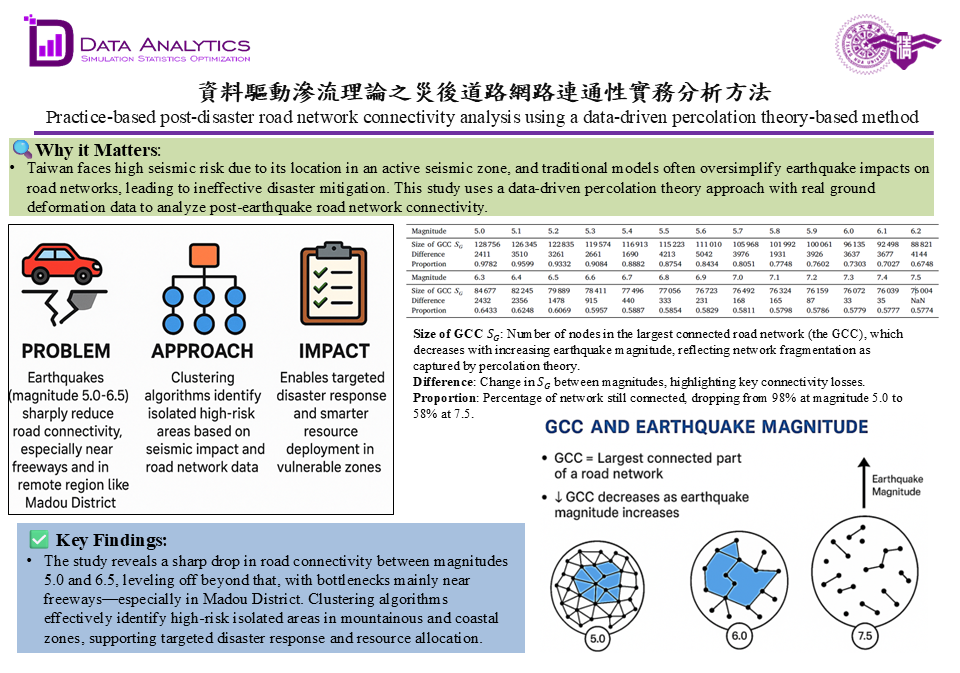
Resilient Decision Support under Uncertainty
Our work in this domain leverages optimization technologies for scenarios defined by high uncertainty, including disaster prevention, healthcare, and energy management.
• Technical Highlights: Utilizes Simulation Optimization, Two-stage Stochastic Programming Models, and Data-driven Network Flow Models.
• Industry/Social Solutions & Empirical Results:
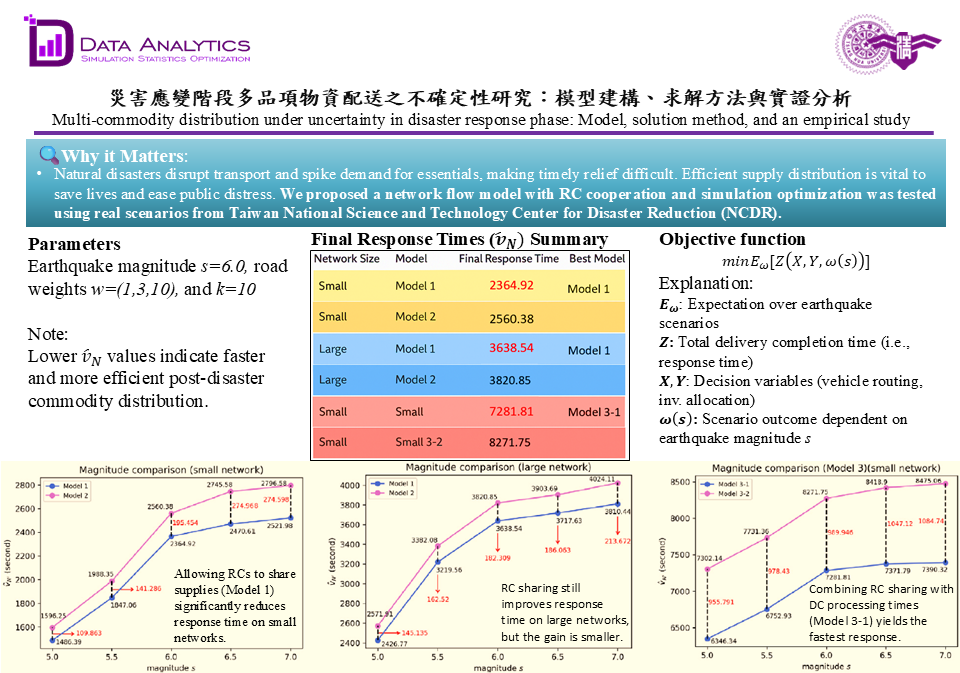
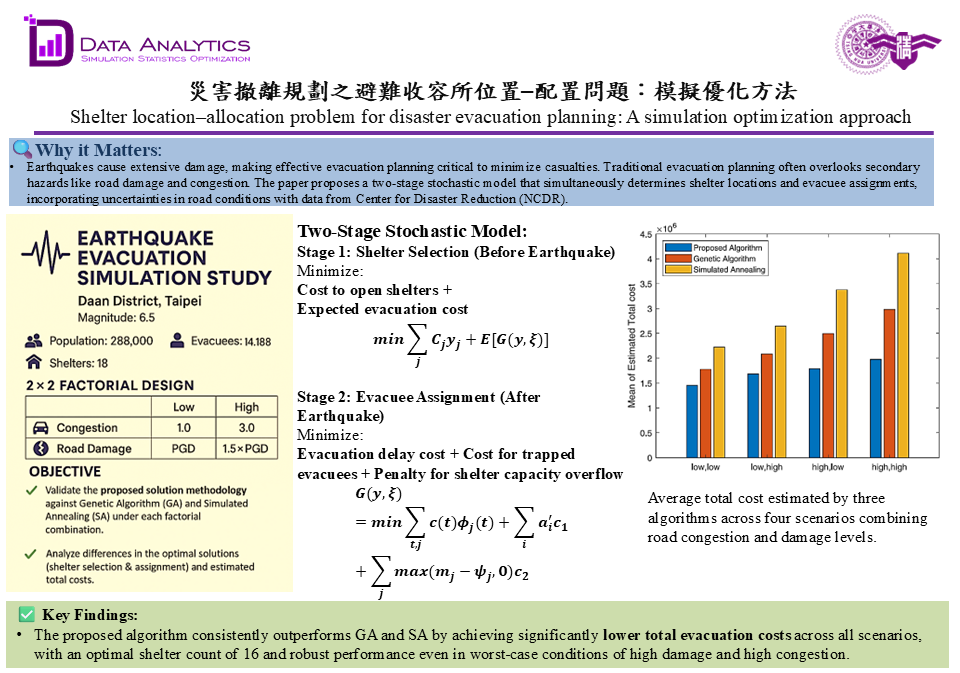
◦ Reduction of Disaster Costs: Material distribution models shortened rescue times, while the optimization of shelter locations reduced evacuation costs and casualties.
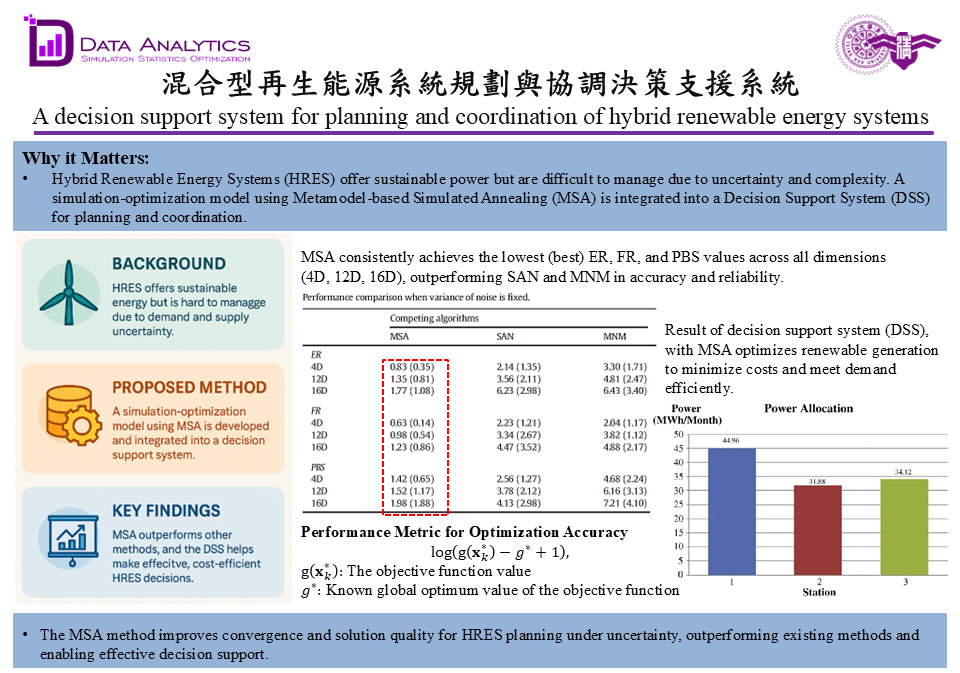
◦ Energy System Planning: Hybrid Renewable Energy Systems (HRES) optimized operations to minimize costs while fully meeting electricity demands.
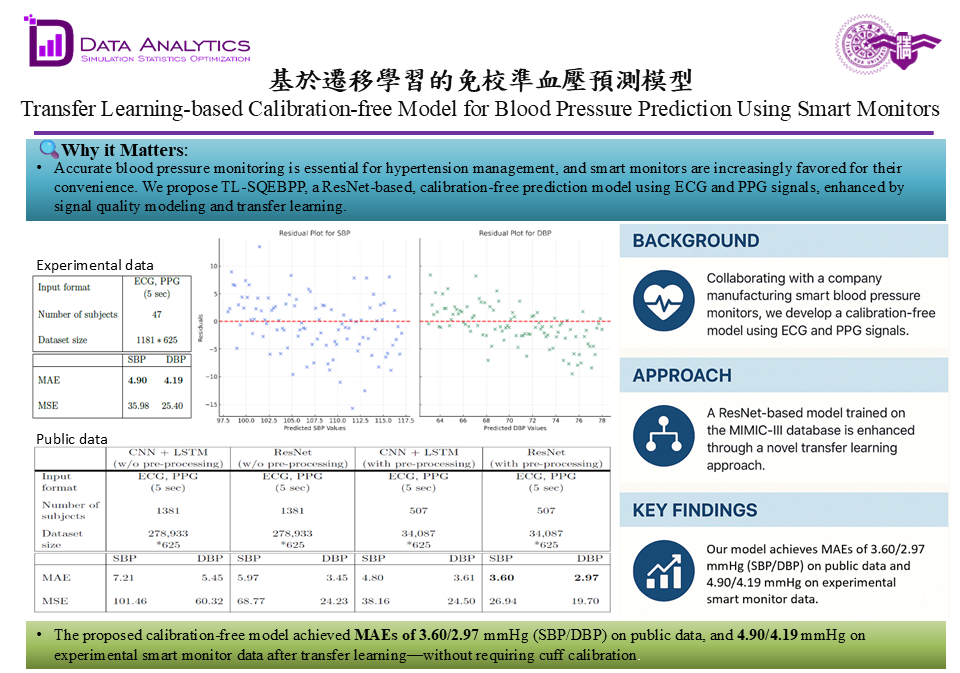
◦ Medical Monitoring Innovation: Developed a "calibration-free" blood pressure prediction model, enabling smart wearable devices to monitor blood pressure with high precision.
• Technical Highlights: Utilizes Simulation Optimization, Two-stage Stochastic Programming Models, and Data-driven Network Flow Models.
• Industry/Social Solutions & Empirical Results:
◦ Reduction of Disaster Costs: Material distribution models shortened rescue times, while the optimization of shelter locations reduced evacuation costs and casualties.
◦ Energy System Planning: Hybrid Renewable Energy Systems (HRES) optimized operations to minimize costs while fully meeting electricity demands.
◦ Medical Monitoring Innovation: Developed a "calibration-free" blood pressure prediction model, enabling smart wearable devices to monitor blood pressure with high precision.