Lesson 1-2
Learning Targets
- I can make predictions about what happens to different materials when we throw them away
- I can use a video to learn about what happens to garbage when we throw it away
Materials
- Science and engineering notebook (SEN)
- Lesson 1-2: Notes on the Landfill Video (optional)
- Video: Landfill
- Chart paper with pictures of garbage around the world from Lesson 1-1
- List of garbage categories created in Lesson 1-1
- Chart paper
Lesson Instructions
Select each section below for full instructions. When you see the following symbols within the instructions, select them for additional information:
 Guidance on how to support newcomer students
 Link to the SISL Video Library to see relevant practices in action
Make Predictions About What Happens to Garbage Materials
Remind students of what they did in Lesson 1-1 and point to the chart paper with the photos from Lesson 1-1. Ask students to share the questions they wrote about the photos at the end of Lesson 1-1. As students share their questions, chart them in front of the class. Some of the wonderings might already be phrased as a question (e.g. “How did that garbage get into the ocean?”) but some of the ideas might be statements (e.g. “The garbage is hurting the animal”). Accept all of the ideas, regardless of how they are shared.
Share with them the list of the garbage categories that was created in Lesson 1-1. Tell the students that they will talk in their triads to make predictions about what will happen to each category and ask them to think about why they are making that prediction. Explain that predictions are our ideas about what we think will happen. Scientists make predictions before investigating.
Before sending them off to talk in their groups, do the first category together to model creating a flow chart. At this point, do not correct students’ ideas. For example, with the category “plastic,” students might predict that it goes into the recycling bin, then to a recycling dumpster, and then to a recycling factory or plant where they melt it into other plastic. You might record this as a flow chart like this:
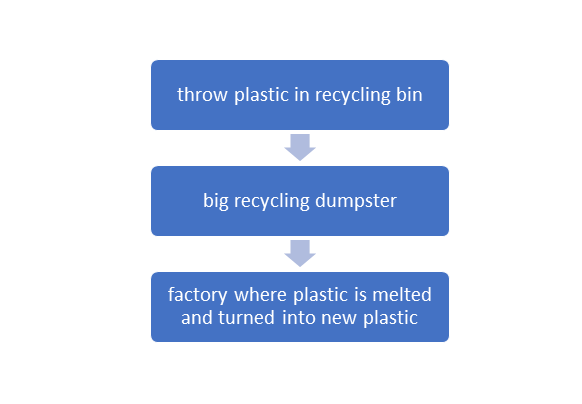
While triads are talking, circulate around the room to make sure all students are included and engaged. To encourage students to share and make their thinking explicit, you can ask: “Why are you making that prediction?”
Supporting Your Newcomer Students
Pay attention to newcomers’ engagement in small group triad discussions. Provide feedback and redirection to them and their language buddies as needed, referring back to the expectations you established with them in Lesson 1-1.
After the triads have made their predictions, ask each group to share their ideas about one category of garbage. Accept all reasonable predictions even if they are inaccurate.
Watch Landfill Video
The purpose in watching the video is to begin to develop students’ ideas about what happens to our garbage once it leaves our schools and homes as well as help them generate more questions. Let the students know that there isn’t any talking or explaining in this video but rather a series of videos that tells the story of what happens to our garbage. Let students know that the video is very short, less than three minutes, and their job is to watch the video carefully for the following things:
- Where does the garbage go?
- What do you see in the garbage?
- What do you want to know more about?
It is important to share these questions BEFORE showing the video as these questions will help focus students’ attention. Either have students write the questions down in their SENs with space for note-taking prior to viewing the video or distribute Lesson 1-2: Notes on the Landfill Video. (Explain that students will be recording their ideas and questions in the note-taker, either on the handout or in their SENs.)
Supporting Your Newcomer Students
Set a clear purpose for viewing the video and make sure your newcomer students understand the three questions that are guiding their viewing.
Invite them to take notes on the video in their home language since the video moves quickly.
Because the video is so short, we recommend playing it twice and giving students time after the first viewing to discuss the questions in their triads and record their responses in their SENs. Then have students add to their notes after the second viewing.
Be sure to model wondering statements at the end of watching the video before sending students off to do that writing by themselves (e.g., “I’m wondering what happens to all of this garbage at the landfill, I’m wondering what happens if the landfill is full, etc.”).
SISL Practices in Action
In this video from the SISL Video Library, you can see how the SISL curriculum uses video to pique curiosity and encourage students to generate ideas and wonderings about scientific phenomena.
While students are writing their ideas down, circulate amongst the triads to encourage students to share and build on one another’s ideas. Express interest and curiosity about their ideas, for example: “Oh wow, I wonder about that too; I didn’t notice that, what a great observation!”
Reflect on Predictions
To close the lesson, ask students to reflect on how their thinking about what happens to garbage has changed.
“Were our predictions true? What new ideas did we get from the video?”
Have students briefly discuss these questions in triads. Bring the class together and choose a few groups to share their reflections.