Lesson 1-3
Learning Target
- I can create a model of the garbage disposal system
Materials
- Science and engineering notebook (SEN)
- Lesson 1-3: Thinking About the Garbage Handling System (optional)
- Sticky notes
- Smaller chart paper (11x17 paper or chart paper cut in half)
- Sticky notes
Lesson Instructions
Select each section below for full instructions. When you see the following symbols within the instructions, select them for additional information:
 Guidance on how to support newcomer students
 Link to the SISL Video Library to see relevant practices in action
Create Home Garbage System
During this lesson students will develop a model of the garbage disposal system that includes the system’s components and how those components interact.
This will be the first lesson in which students develop a model. Modeling will play a central role in the unit. Because modeling may be a new science practice for students, start by guiding the class in developing part of the model together.
“Today we are going to talk about how the garbage from our homes, school, and community get to the landfill. We are going to create a model that represents the garbage system.”
“We are going to create part of the system together and then I am going to ask you to work in your triad to create the remaining parts of the system.”
Post on the board “Home” and “Home Garbage” (on sticky notes).
“Let’s think about the garbage we make at home. What can you tell me about your garbage at home? What do you do with your garbage at home?” (Throw it away, put it in a garbage can.)
Write “Garbage Can” on a sticky note and put it on the board. If recycling doesn’t come up, ask the students about recycling in their homes. Add it to the board.
Supporting Your Newcomer Students
As you create the whole class example model for home garbage, make sure to amplify your language and monitor newcomers’ engagement. Use gestures, point, and annotate the sticky notes with images of the components (e.g., drawing a garbage can or truck) to support their listening comprehension.
“What happens to the garbage in the cans?” (It goes into bigger garbage and recycling cans outside.)
Add “Outside Garbage” and “Recycling Cans” to the board. Use arrows to connect the components in the model (see example display below).
“What happens to the garbage and recycling outside?” (The garbage truck picks it up.)
Add “Garbage Truck” to the model.
“What happens to the garbage in the garbage truck? What about the recycling?” (It goes to the landfill or recycling center.)
Add “Landfill” and “Recycling Center” to the board.
Example display (see red outline for home garbage system):
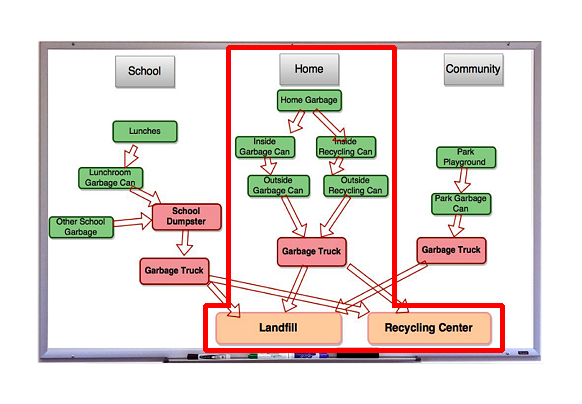
“All of the parts you just named are called components. When components work together it makes a system. So what we just created on the board represents a system for handling our garbage at home.”
Create School and Community Garbage Systems in Triads
Following the home garbage example, ask triads to identify the components of the school and community garbage systems.
Assign each triad one of the systems—either school or community garbage—to focus on and give each group a small piece of chart paper and sticky notes. Students should work in their triads with sticky notes to determine the different components of the system and use arrows to represent how those components work together.
As the triads are working, circulate amongst the groups. If groups are having a hard time getting started or deciding how to organize their components, ask questions that focus on the components of the system and how they work together (e.g., “What can you tell me about the components or parts of your system? Where do you think the garbage goes first? Then what happens to it? How do the components of your system work together?”).
SISL Practices in Action
In this video from the SISL Video Library, you can see how a teacher circulates strategic to make sure newcomer students are engaged in interaction and science inquiry.
As you circulate, make sure all students, including newcomers, are engaged in the work and discussion.
Supporting Your Newcomer Students
As students work in triads, continue monitoring the triads with newcomer students to make sure that these students are engaged and supported.
Share and Make Observations about School and Community Garbage Models
Bring the class together and ask the “School Garbage” and “Community Garbage” groups to share the components and how they work together. Post these components on the board next to the Home Garbage Model you created with the class.
Once the three systems are posted, ask students to make observations about the systems. If students do not notice the similarities and differences between the systems, prompt them to make note of this.
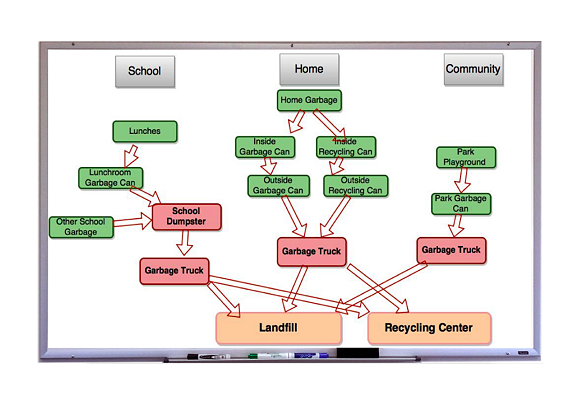
Describe what the class created: “On the board, we made a model that describes several garbage disposal systems: the school lunch garbage, home garbage, and other community garbage (e.g., from parks). This display shows the components of each system. Arrows connect one component to another when the components work together. It also shows how garbage flows into, through and, in some cases, out of one component system and into another.”
“When scientists and engineers decide on a system and show the components and their interactions, that’s a system model. Our class made a system model today that contains several systems that connect together, making one larger system.”
Generate New Questions and Ideas
Tell students: “Thinking about garbage handling as a system might have made you think of more questions. Let’s take a few minutes to think about any new questions or ideas that you have.”
Give students a few minutes to share their questions and ideas with the whole class. Chart their ideas on the board. Then send students back to their small groups to discuss and write their ideas and questions in their SENs. You can either hand out Lesson 1-3: Thinking About the Garbage Handling System, have them create a simple chart in their SENs to record their ideas and questions, or have them write their questions and ideas on a page in their SENs in list form.
Supporting Your Newcomer Students
There is now a lot of environmental print from this lesson and previous lessons that newcomers can use to support their emerging English writing. Make sure to keep the charts from previous lessons visible so students can refer to them as resources. Encourage them to use these resources to push themselves to write what they can in English. However, you don’t want students to be limited by what they can express only in English, so you can also invite them to write in a combination of English and their home language.