About

Haoyu Hu

PhD student @ CO3 Lab, Cornell University.

I study human, AI and their collaboration.

Human-AI Collaboration AI Alignment Self-Improving AI Cognition Healthcare

Projects

Selected Publications

For full publication list, see: https://scholar.google.com/citations?hl=en&user=eRIh1b0AAAAJ.

2026
Why Human Guidance Matters in Collaborative Vibe Coding

Why Human Guidance Matters in Collaborative Vibe Coding

Haoyu Hu, Raja Marjieh, Katherine M. Collins, ..., Ilia Sucholutsky, Nori Jacoby

Under review

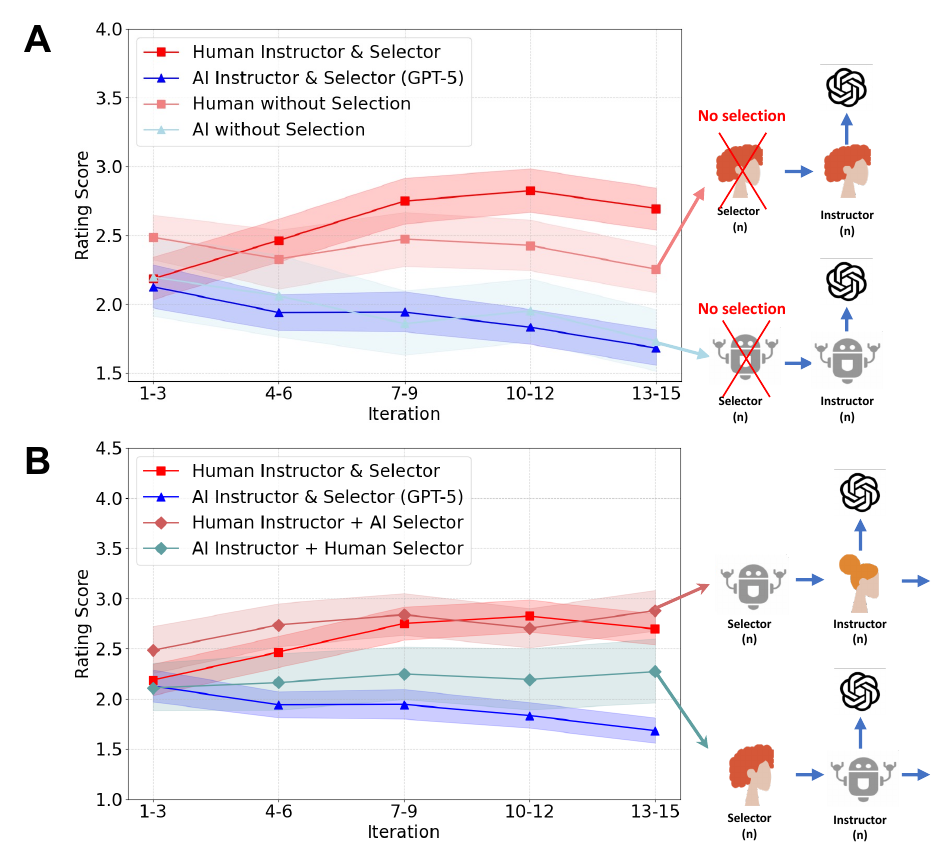
We introduce a controlled experimental framework for collaborative vibe coding and compare human-led, AI-led, and hybrid groups across 20 experiments with 737 participants. The results show that people contribute uniquely effective high-level guidance, while AI-provided instructions can drive performance collapse. Hybrid systems perform best when humans lead instruction and AI supports evaluation, highlighting the continued importance of human guidance in future hybrid societies.

2025
Explainable AI as a Double-Edged Sword in Dermatology: The Impact on Clinicians versus The Public

Explainable AI as a Double-Edged Sword in Dermatology: The Impact on Clinicians versus The Public

Xuhai Xu, Haoyu Hu, Haoran Zhang, ..., Philipp Tschandl, Roxana Daneshjou, Marzyeh Ghassemi

Nature Medicine, Accept in Principle

Across two large-scale dermatology experiments with lay users and primary care physicians, AI assistance improved accuracy and reduced disparities across skin tones. At the same time, multimodal LLM explanations showed a double-edged effect: they increased automation bias for the general public, while experienced clinicians remained more resilient and still benefited even when AI was wrong. The study clarifies how expertise and decision timing reshape human-AI collaboration in medical diagnosis.

MindLLM: A Subject-Agnostic and Versatile Model for fMRI-to-text Decoding

MindLLM: A Subject-Agnostic and Versatile Model for fMRI-to-text Decoding

Weikang Qiu, Huang Zheng, Haoyu Hu, Aosong Feng, Yujun Yan, Rex Ying

ICML 2025

MindLLM combines a subject-agnostic fMRI encoder with an off-the-shelf large language model to decode brain activity into text across multiple subjects and tasks. The model improves downstream task performance, generalization to unseen subjects, and adaptation to new tasks, while its neuroscience-informed attention mechanism offers interpretable insight into how semantic information is encoded from fMRI signals.

2024
D-CoRP: Differentiable Connectivity Refinement for Functional Brain Networks

D-CoRP: Differentiable Connectivity Refinement for Functional Brain Networks

Haoyu Hu, Hongrun Zhang, Chao Li

MICCAI 2024

D-CoRP is a differentiable plugin for refining noisy functional brain network connectivity with an information bottleneck objective. It denoises edges while remaining flexible enough to plug into existing graph neural network backbones, leading to stronger performance across multiple datasets and demonstrating a practical path for more reliable brain-network analysis.

Blog

Notes and Project Stories

Longer-form writing about project design, experiments, and what I learn while building human-AI systems.

March 30, 2026 5 min read

When More Feedback Makes AI Worse: Building Iterative Collapse Detection

Everyday AI use comes with a familiar frustration: sometimes the model does not follow the original instruction, and repeated correction does not help. In the worst cases, the answer drifts farther away from the task, accumulates unnecessary changes, or becomes harder to trust turn after turn.

That failure mode is the motivation behind iterative-collapse-detection, a project for studying whether multi-round refinement actually improves model behavior or whether it can trigger a gradual collapse in quality instead. The codebase brings together a standardized multi-turn benchmark, reproduction runners, dataset preparation, evaluation, logging, and analysis utilities in one place. The project repository is here: github.com/Haoyu-Hu/iterative-collapse-detection.

March 30, 2026 5 min read

Simulating Real-World Vibe Coding with Different Kinds of Users

One concern I had after our earlier work on collaborative vibe coding was that the task setup was still cleaner and simpler than many real coding interactions. Real-world vibe coding is messy: users differ a lot in how much they know, how much they trust the model, what kinds of failures they can actually notice, and how clearly they can describe those failures back to the agent.

That is the motivation behind vibe-coding-simulator, a project for turning vibe coding into a controlled multi-round experiment without stripping away the social structure that makes it interesting. The project repository is here: github.com/Haoyu-Hu/vibe-coding-simulator.

Education

Academic Training

Cornell University

Department of Psychology

PhD student in Psychology

GPA: 4.0/4.0

Aug 2025 - present

Ithaca, US

University of Cambridge

Department of Clinical Neurosciences

PhD (no degree) in Clinical Neurosciences

Jan 2024 - Jan 2025

Cambridge, UK

Zhejiang University, Chu Kochen Honors College

BS in Psychology with Honors

GPA: 3.87/4.0

Sept 2019 - Jun 2023

Hangzhou, China

Contact

Get in Touch

You can usually find me in or around the Human Ecology Building at Cornell. The easiest way to reach me is by email.