Labnotes | Ang kontradiksyon ng renewable energy transition sa Pilipinas
Sino ang may-ari ng mga planta, sinu-sino ang may kontrol ng transmisyon at distribusyon, at para saan ba talaga ang Electric Power Industry Reform Act?

ADVERTISEMENT

Sino ang may-ari ng mga planta, sinu-sino ang may kontrol ng transmisyon at distribusyon, at para saan ba talaga ang Electric Power Industry Reform Act?

Losing CMFR feels a lot like losing a home.


I spent more hours in the waiting area than in my consultations. Most of my conversations with the doctor took only 15 to 30 minutes.

On September 23, 1972, the day Martial Law was announced, Ferdinand Marcos was certain — or, at the very least, he was determined to sound like it.

These movements expose the Luzon Economic Corridor not as a national development plan, but as a violent mechanism of US-led imperialist plunder and war that converts sovereign land into an extractive garrison for foreign capital while forcing dispossessed rural populations into the precarious ranks of the informal semi-proletariat.


“Panginoon, ilang beses ko po ba dapat patawarin ang aking kapatid na nagkakasala sa akin? Hanggang pitong beses po ba?”

Her death should serve as a stark reminder: a feminism that aligns itself with the empire is no feminism at all—it is merely the soft edge of oppression.


Women continue to face discrimination, violence, abuse, and the denial of their dignity. Patriarchy has become so deeply woven into our society and even our churches, that it is sometimes treated as normal.

Kung ayaw nating habang-buhay na mabuhay sa takot sa mga multo ng ating lipunan, kailangan nating manatili kay Hesus. Siya ang nagtagumpay laban sa kasamaan, sa kawalang-katarungan, at maging sa kamatayan.

While Pax Silica is framed as a promising venture between two longtime allies against China, history shows a picture of wanton labor exploitation, aggressive land conversion and expansion, and massive resource extraction.

If the United States were forced to acknowledge its own long history of aggression against Cuba—the invasion, the assassination attempts, the economic warfare, the occupation of Guantánamo—the report's narrative of Cuban "subversion" would collapse. The aggressor would be revealed as the victim, and the victim as the aggressor.
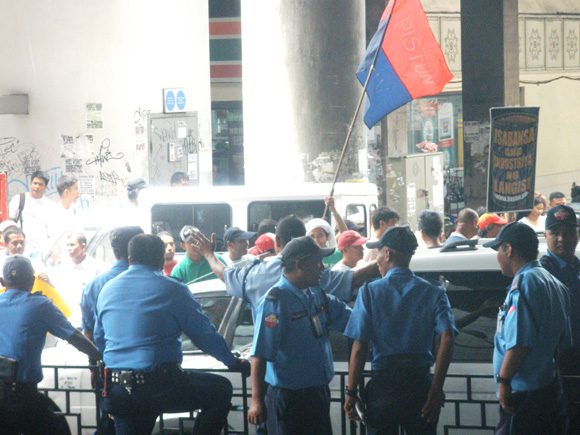
Nagkaroon lang ng tsapa, akala’y kung sino na. Kung makapagsalita, mistulang diyos-diyosan sa kalsada.

The pre-colonial Ivatan society, defined by its fortified idjangs (mountain fortresses) and autonomous participation in the Maritime Jade Road, was a sovereign entity. To subsume their heritage under a Chinese claim based on ancient trade networks or proximity is an epistemic assault.

Kapag binabasa natin ang talinhaga ng manghahasik, madalas na nakatuon ang ating pansin sa iba’t ibang uri ng lupa. Ngunit kung babalik tayo sa mismong tagpo ng Ebanghelyo, may isang taong hindi natin gaanong napapansin—ang manghahasik. Siya ang unang lumabas. Siya ang unang nagpagod. Siya ang unang umasa.

Stories from West Papua, Myanmar, the Philippines—and across Asia-Pacific—reveal more than opposition.
A community of readers and supporters that help us sustain our operations through microdonations for as low as $1.