
Dangote, foreign interests, and local collaborators

When Aliko Dangote speaks, Africa listens, not merely because of his humongous wealth but because of the symbolic place he occupies in the continent’s uneasy conversation with what the late economists, Professor Eskor Toyo, famously described as “agbero capitalism”, development, and sovereignty. His recent assertion that foreign interests are working against Africa’s growth is neither novel nor surprising, but it demands interrogation and invites us to revisit an old argument that has animated African political thought for decades, namely that the continent’s underdevelopment is not accidental but engineered from outside its borders. The question, however, is whether this argument, compelling as it sounds, tells the whole story or obscures a more uncomfortable truth about the role Africans themselves play in sustaining the structures that inhibit their own progress.
Dangote’s claim situates him, perhaps unwittingly, within a long tradition of anti-imperialist scholarship that’s most powerfully articulated by thinkers like Frantz Fanon in Wretched of the Earth and later developed by Walter Rodney in How Europe Underdeveloped Africa. These thinkers argued, with considerable force, that Africa’s poverty is the historical product of exploitation by European powers, whose colonial ventures extracted wealth, distorted local economies, and integrated African states into a global system designed to serve the interests of the Western metropolis. In this view, underdevelopment is not a natural condition but a relationship that benefits Europe and impoverishes Africa.
Much in this argument remains persuasive.
The legacy of colonialism is not a ghost that vanished at independence but a structure that persists in trade patterns, financial systems, and political institutions. African economies continue to export raw materials and import finished goods. The patterns that entrench dependency and limit industrial growth often take the form of international financial institutions, which prescribe policies that prioritise fiscal discipline over social investment, reinforcing cycles of austerity that further weaken already weak African states. Dangote’s claim that foreign interests work against Africa’s growth resonates with a historical reality that cannot be dismissed with the sleight of hand.
That insight has been deepened by other scholars who examined the link between external domination and internal collaboration. Ronald Robinson and John Gallagher, in Africa and the Victorians, for instance, argued that empire did not expand by force alone but through alliances with local rulers and elites who found advantage in cooperating with imperial power. This idea of collaboration helps explain how foreign control could take root and endure with limited resistance. In a similar vein, Andre Gunder Frank advanced the dependency thesis, insisting that the global capitalist system creates a chain of exploitation in which wealth flows from the periphery to the centre, while Samir Amin extended this argument by showing how African economies were deliberately structured to remain subjugated, producing raw materials for external markets rather than developing local capacity. But, within these frameworks, there is a clear recognition that local actors are not passive victims but active participants who sustain these unequal relationships. Their work reinforces the point that external domination succeeds not simply because of its strength, but because it finds willing partners within, making the problem of underdevelopment as much an internal question as an external one.
However, to accept this argument without qualification is to risk falling into a dangerous determinism driven by convenience. A convenient determinism that absolves Africans of responsibility and reduces complex internal dynamics to external manipulation. It is at this point that the question must be asked, gently but firmly: whether Dangote himself stands entirely outside the imperial system he criticises, or whether he is, in some ways, a beneficiary of it? Dangote’s empire, vast and diversified, operates within the very global economic structures that critics of imperialism often condemn. His industries rely on international capital, global supply chains, and state protections that are themselves shaped by the logic of contemporary agbero capitalism.
This does not invalidate his criticism, but it complicates it by blurring the line between victim and participant.
Fanon, whose work is often invoked in these debates, was acutely aware of this complexity. He warned not only of the dangers of external domination but also of the emergence of a national exploiter class that would inherit the colonial state and reproduce its logic under a different flag. This class, he argued, would be more concerned with maintaining its privileges than with transforming the economic structures that sustain inequality. In his analysis, the postcolonial elite would lack the productive capacity of the European bourgeoisie and would instead act as intermediaries, facilitating the continued extraction of wealth from their own states. One finds a telling illustration of this in the manner in which Chinese mining interests, often in concert with local actors, continue to extract and exploit the mineral wealth of certain subnational states, with limited oversight and little regard for long-term development.
This insight finds a profound echo in Rodney’s work, which emphasised that underdevelopment is a process involving both external and internal actors. While Europe played a central role in shaping Africa’s economic trajectory, African rulers and elites have often collaborated, willingly or otherwise, in maintaining structures that disadvantage their own people. The language of foreign interference, therefore, while not incorrect, can become a shield behind which local failures are concealed.
The concept of local collaborators is not merely rhetorical. It is a critical analytical tool that helps us understand why many African states, decades after independence, struggle to achieve meaningful development. Scholars across disciplines have pointed to how political elites engage in rent-seeking, prioritise short-term gains over long-term planning, and align their interests with external actors at the expense of their own citizens. This collaboration is not always explicit, nor is it always driven by malice. It often emerges from structural incentives that reward compliance with global norms while penalising deviation.
In this context, I find Dangote’s call for stronger regional integration to be timely and necessary. The idea that the African Continental Free Trade Area can succeed only if regional markets are functional recognises the need for internal coherence. However, regional integration itself is not immune to the problem of local collaboration. Without accountable leadership and transparent institutions, integration risks becoming another arena in which elites negotiate benefits for themselves while ordinary citizens see little improvement in their lives.
The challenge, therefore, is not to reject Dangote’s claim outright but to situate it within a broader framework that acknowledges both external pressures and internal dynamics. Foreign interests do indeed shape Africa’s economic environment, often in ways that are unfavourable to the continent. But these interests do not operate in a vacuum. They interact with local collaborators who have agency, who make choices, and who bear responsibility for the outcomes of those choices. An exclusive focus on external factors is to simplify a complex reality and to miss an opportunity for introspection, overlook the ways in which governance failures, corruption, public policy inconsistency undermine development efforts, and ignore the fact that some of the most significant barriers to growth are rooted in political cultures that prioritise power over service and loyalty over competence. They are homegrown.
The arguments here aren’t for self-flagellation, nor is it a denial of the enduring impact of colonialism. It is, rather, a call for balance, a recognition that the path to development requires both resistance to external exploitation and subjugation. Africa’s future will not be determined solely by what happens in Washington, London, or Brussels but also by decisions made in Abuja, Nairobi, and Accra. At the heart of it all, the question is not whether foreign interests work against Africa’s growth, for in many cases they do, but whether Africa’s rulers and elites are willing to confront their own role in sustaining the conditions that enable such interference. Dangote’s voice, influential as it is, should not only challenge the global order but also provoke a deeper examination of the local structures that shape Africa’s destiny. Only then can the conversation move from meaningful interrogation of the African condition to the irresponsibility of its rulers and elites.
Abdul Mahmud, a human rights attorney in Abuja, writes weekly for The Gazette

We have recently deactivated our website's comment provider in favour of other channels of distribution and commentary. We encourage you to join the conversation on our stories via our Facebook, Twitter and other social media pages.

More from Peoples Gazette

Agriculture
FG tasks ECOWAS on leveraging financing strategies for agroecology
The federal government has urged stakeholders in the agriculture and finance sectors in the West Africa region to leverage financing strategies to enhance agroecology practices

Politics
Katsina youths pledge to deliver over 2 million votes to Atiku
“Katsina State is Atiku’s political base because it is his second home.”
World
Iran has not sent delegation for U.S. talks in Pakistan: Report
Iran has not yet sent any representatives for talks with the United States in Islamabad, according to state media.

World
Red Cross launches emergency aid operation for ravaged Afghan communities
According to the ICRC, approximately 136,000 people, representing around 17,000 households in the districts of Kamdesh and Barg-e-Matal, have faced acute food shortages.

States
Several terrorists killed Monday in precision airstrikes: NAF
The Nigerian Air Force says it executed precision airstrikes within the Yuwe axis of the Sambisa Forest, killing several terrorists on Monday.

World
Labour secretary Lori Chavez-DeRemer quits Trump administration
Ms Chavez-DeRemer has been under pressure for months over several investigations.
States
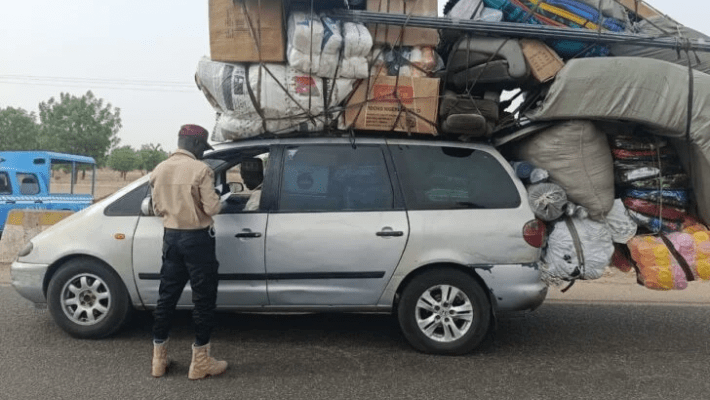
FRSC nabs driver of overloaded vehicle
”Overloading compromises vehicle stability, increases stopping distance, and puts both passengers and other road users in grave danger,” said FRSC.

Education
Nursing council inducts 54 Danfodiyo graduates
The Nursing and Midwifery Council of Nigeria has inducted 54 nurses from the Department of Nursing Sciences, Usmanu Danfodiyo University, Sokoto.


