Scam check
Is DentaVive a Scam? Claims, Evidence and Refund Terms
DentaVive's sales page publishes testimonial-style claims about bleeding gums, avoided dental procedures and A1C. This check distinguishes those vendor-selected stories from verified product evidence.

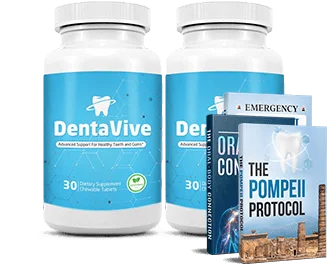
DentaVive's sales page publishes customer-testimonial cards claiming changes in bleeding gums, dental procedures and A1C. Those stories are not clinical evidence, and no published human trial identified here tests the finished product for those outcomes.
Affiliate link. We may earn a commission at no cost to you. How this works.
On this page
What the sales claims promise
DentaVive’s central problem is the distance between the stories on its sales page and the evidence available for the finished formula. The page publishes customer-testimonial cards in which Margaret says her bleeding stopped within two weeks; Janet says her bleeding stopped after six weeks and that procedures were no longer needed after three months; Robert says that after three months his dentist no longer recommended $15,000 of root canals, crowns and possible implants; and Carlos says his gums healed and his A1C improved within six weeks. These are vendor-selected testimonials, not independently verified outcomes. No published human trial identified for this review tests the complete formula for those results.

The regulatory distinction also matters. The FDA separates structure/function language from claims tied to diagnosing, treating, curing, or preventing disease. DentaVive’s page carries the standard FDA disclaimer, but a disclaimer does not verify the outcomes described in customer stories. This review therefore treats the gap as a claims-and-evidence problem rather than declaring the product legal or illegal.

No published human trial has tested the DentaVive formula itself. So I can’t tell you it works for anything it promises, because there is no evidence on the actual product to point to. That is not me being coy. The studies simply don’t exist.
What the wider research does show is far more modest, and it is tied to specific bacterial strains, not to the word “probiotic” in general. Taken on its own, the strongest gingivitis review found no clear advantage for the Lactobacillus reuteri subgroup over a placebo and rated the overall evidence weak PMID 31682012 (DOI).

A separate meta-analysis found a small, short-term benefit for the DSM 17938 plus ATCC PTA 5289 pair only as an add-on to professional deep cleaning PMID 32373987 (DOI). Another strain, Streptococcus salivarius BLIS K12, may help reduce sulfur compounds behind bad breath, again as an adjunct PMID 40951721 (DOI). None of those studies tests DentaVive or verifies the outcomes in its testimonial cards.
That leads to the hardest and most important line on this page. No supplement regrows lost gum tissue or re-anchors a loose tooth. That is surgery and periodontist territory, full stop. Bleeding gums and loose teeth are signs of gum disease that need a professional, so please see a dentist or periodontist rather than a bottle. A good oral probiotic is, at best, a studied add-on to real cleaning, never a replacement for it. You can see exactly how I weigh this evidence on how we test, and what the science actually supports on the gum disease explainer.
One more caution, because the A1C angle makes it necessary. A1C is a blood-sugar measure that belongs to you and your doctor, not a supplement label. I can’t call DentaVive “safe,” because the specific formula hasn’t been tested and supplements aren’t checked for approval before they sell. If you manage diabetes or take any prescription, an unproven blend could interact with your medication, so clear it with your doctor or pharmacist first.
Adding it up
What checks out
- A ClickBank checkout was available when reviewed, confirming an offer listing rather than fulfillment.
- ClickBank publishes return terms and a request route; the live product window and instructions still need verification.
The red flags
- Vendor-published testimonials describe root canals, crowns and possible implants becoming unnecessary after three months, without independent verification.
- Other testimonial cards say bleeding stopped within two or six weeks; customer stories are not clinical proof.
- A testimonial says gums healed and A1C improved within six weeks, reaching into dental and blood-sugar outcomes that need clinical evidence.
- No published trial of the formula, so product-specific proof is simply absent.
How this compares to a more transparent pick
I want to be fair here, because the easy move would be dishonest. The real difference isn’t that DentaVive is fake and my pick is magic. Nearly everything in this category, including the products I do recommend, sells through the same kind of online funnel, with the same countdown timers and “only a few bottles left” nudges. Those pressure tactics are category-wide noise, and I don’t treat them as proof of fraud.
The differences that actually count are boring and checkable: a more detailed label, claims that stay within the evidence, and public documentation a reader can inspect. ProDentim is better documented than DentaVive, but not fully transparent: BL-04 is named, while its L. reuteri and S. salivarius lack strain codes and individual doses are not disclosed. That is the same yardstick used in the best oral probiotics.
| What matters before you buy | DentaVive | A named pick (e.g. ProDentim) |
|---|---|---|
| ClickBank offer listing observed | Yes | Yes |
| Refund terms | Verify current checkout terms | Verify current checkout terms |
| Customer outcomes presented in marketing | Bleeding, procedures and A1C claims in vendor-selected testimonials | More restrained, but no finished-formula trial |
| Strain and dose disclosure | Incomplete | Partial: BL-04 is named; L. reuteri and S. salivarius have no codes; individual doses are not disclosed |
| Published trial of the finished formula | None identified | None identified |
| Research can be matched to the label | Not reliably at strain level | Limited to disclosed ingredients; not Prodentis or BLIS K12/M18 |
Read that table as transparency against transparency, not scam against saint. Neither finished formula has a published trial identified here, and both use a ClickBank funnel. ProDentim provides more label detail, but only BL-04 is strain-coded; its other probiotic species and individual doses cannot be matched to the exact-strain studies often cited in this category.
So if you arrived here cautious, the takeaway is simple. A checkout and a published refund policy do not prove shipment or a completed return, and no finished-formula trial supports DentaVive’s medical outcomes. ProDentim is the better-documented option in this comparison, with the disclosure limits stated above.

Frequently asked questions
Does DentaVive actually work?
There are no published human trials on the DentaVive formula itself, so I can’t say it works for what it claims. For the general category, oral-probiotic evidence is moderate-to-weak and strain-specific: Streptococcus salivarius BLIS K12, for example, may help reduce bad-breath compounds as an adjunct after a cleaning PMID 40951721 (DOI). A supplement is at best an adjunct, not a fix.
Is DentaVive safe, and does it have side effects?
I can’t verify a safety profile, because the specific formula hasn’t been clinically tested. Supplements aren’t pre-approved by the FDA, and ingredients can interact with medications, so check with your doctor or pharmacist first, especially if you take prescriptions or manage a condition like diabetes.
Can DentaVive stop bleeding gums and save loose teeth?
No supplement regrows lost gum tissue or re-anchors a loose tooth, that requires a dentist or periodontist. Bleeding gums and loose teeth are signs of gum disease that need professional care. A probiotic may at most give a short-term benefit as an adjunct to scaling and root planing (Lactobacillus reuteri DSM 17938 plus ATCC PTA 5289) PMID 32373987 (DOI), while the strongest gingivitis analysis found no difference against a placebo when taken standalone PMID 31682012 (DOI).
What are DentaVive’s ingredients?
DentaVive markets a blend of oral probiotics, vitamins and plant extracts, but the label doesn’t always disclose exact strains or doses. Ask for the exact strain names and CFU counts (colony-forming units, the count of live bacteria per serving) before buying, because with oral probiotics the specific strain, not the word “probiotic,” is what any evidence attaches to.
Is DentaVim the same as DentaVive?
No, DentaVim is a separate look-alike product with a near-identical name, one of several soundalikes in this niche. Confirm you’re on the exact official page for whichever product you mean before entering payment details.
Where do you buy DentaVive, and can you get a refund?
It had a ClickBank checkout when reviewed. ClickBank’s Terms of Sale, published April 22, 2025, identify Click Sales Inc. as the buyer’s contractual counterparty, and its Flexible Refunds guidance, dated January 14, 2026, says product-level periods can vary. That is a policy path, not evidence of shipment or a completed refund. Check the current period and return instructions at checkout. If you want the better-documented option, use the comparison above.
What we’d buy instead
DentaVive’s problem is not simply that it uses a ClickBank checkout. It is the gap between vendor-published testimonials about bleeding gums, avoided dental procedures and A1C and the product-specific evidence available to support those outcomes. ProDentim is the more inspectable alternative in this comparison: its oral-focused label names B. lactis BL-04, although its other probiotic species still lack strain codes and individual doses. Read the full review before treating that relative advantage as proof of the finished formula.
Affiliate link. We may earn a commission at no cost to you. How this works.
Still want to try DentaVive yourself?
Use the official listing so the product, checkout and return terms you inspect belong to the same offer. Before paying, save the current ingredient panel and product-specific return window, and do not use a supplement to delay care for bleeding gums, a loose tooth or a possible root-canal problem. ClickBank’s Terms of Sale (April 22, 2025) identify the contractual seller, while its Flexible Refunds guidance (January 14, 2026) says return periods can vary by product; neither source proves performance, delivery or a completed refund.
Affiliate link. We may earn a commission at no cost to you. How this works.
References
-
U.S. Food and Drug Administration. Label Claims for Conventional Foods and Dietary Supplements [Internet]. FDA. Content current as of March 28, 2024; accessed July 17, 2026. Available from: FDA — Label claims for foods and dietary supplements
-
Song D, Liu XR. Role of probiotics containing Lactobacillus reuteri in adjunct to scaling and root planing for management of patients with chronic periodontitis: a meta-analysis. Eur Rev Med Pharmacol Sci. 2020 Apr;24(8):4495-4505. https://doi.org/10.26355/eurrev_202004_21032 · PubMed PMID 32373987
-
Akram Z, Shafqat SS, Aati S, Kujan O, Fawzy A. Clinical efficacy of probiotics in the treatment of gingivitis: A systematic review and meta-analysis. Aust Dent J. 2020 Mar;65(1):12-20. https://doi.org/10.1111/adj.12733 · PubMed PMID 31682012
-
Passadakis G, Neophytou C, Davidopoulou S, Papadimitriou K. Effectiveness of Probiotics in Managing Oral Halitosis: A Systematic Review of Randomized Controlled Trials. J Int Soc Prev Community Dent. 2025 Jul-Aug;15(4):301-312. https://doi.org/10.4103/jispcd.jispcd_19_25 · PubMed PMID 40951721
-
ClickBank. ClickBank Terms of Sale [Internet; terms of sale]. Published April 22, 2025; page states “Last Updated: May 2, 2024”; accessed July 17, 2026. Available from: ClickBank Terms of Sale
-
ClickBank. Flexible Refunds [Internet; refund policy guidance]. Published January 14, 2026; accessed July 17, 2026. Available from: ClickBank Flexible Refunds
Who's behind this