

UN nuclear non-proliferation talks fail, countries disagree on consensus document
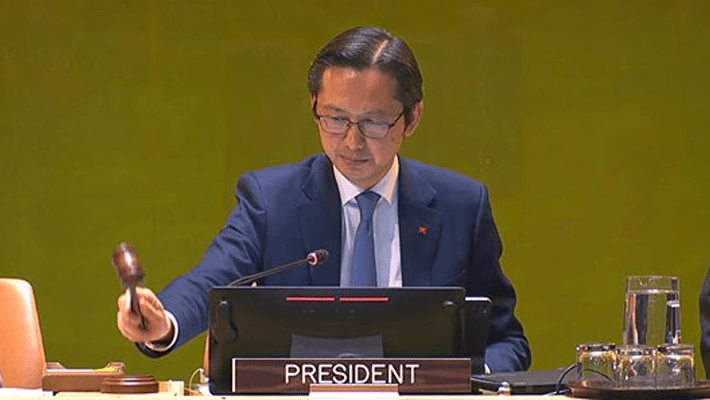
“This document reflects my best effort to capture the range of views expressed across the Treaty’s three pillars: nuclear disarmament, non-proliferation and the peaceful uses of nuclear energy, as well as the strengthened review process,” said Do Hung Viet, president of the 11th review conference of the Parties to the Treaty on the Non-Proliferation of Nuclear Weapons. “It is the product of weeks of intensive engagement and of a review cycle built on years of preparatory work. “My goal was to make everyone equally unhappy. In that, I think we can all agree that I had made some progress towards that goal.”
The NPT review conference concluded Friday without agreement on a consensus outcome document, even as the international community faces mounting and interrelated threats (from the spectre of nuclear weapons use in active conflicts, to attacks on nuclear facilities, to the destabilising implications of emerging technologies, such as artificial intelligence).
Mr Viet said he had put forward four versions of the draft outcome document, all painstakingly revised in line with participating nations’ wishes.
“Despite our best efforts, however, it is my understanding that the conference is not in a position to achieve agreement on its substantive work,” Mr Viet said. “I do not intend to put the document forward for adoption”.
Despite four weeks of meetings and negotiations, countries were unable to resolve differences and reach a consensus, marking the third consecutive conference to fail to do so.
The NPT is a cornerstone international agreement aimed at preventing the spread of nuclear weapons, advancing nuclear disarmament and promoting the peaceful use of nuclear energy. Built on those three pillars, it requires non-nuclear-weapon States not to acquire nuclear arms, while nuclear-weapon States commit to pursuing disarmament under Article VI.
Entered into force in 1970 and now with 191 States parties, the NPT is reviewed every five years to assess its implementation and progress. Despite its near-universal membership and continued legal force, the Treaty is currently under strain, with recent review cycles failing to reach a consensus outcome.
Mr Viet regretted that, after weeks of “intensive engagement”, “years of preparatory work” and “despite our best efforts”, the meeting was “not in a position to achieve agreement on its substantive work”.
The document reflected best efforts to capture the range of views expressed across the treaty’s three pillars: nuclear disarmament, non-proliferation and the peaceful uses of nuclear energy, as well as the strengthened review process, in an approach that “sought to be inclusive”.
While assuring delegates that the document had been “a genuine attempt to find common ground”, Mr Viet did not put the document forward for adoption.
Yet, he admitted that “delegations do share the goal of a world without nuclear weapons — a world in which the threat of nuclear war does not hang over our heads, or those of our children — even if we differ on how to reach that goal”.
“If we cannot agree on which road to take, we will never arrive at our destination,” said Mr Viet.
Noting that the “NPT is an old treaty” with mechanics that have not been updated in about 26 years, Mr Viet noted that “at that age, even some of the best machines can start to creak”.

We have recently deactivated our website's comment provider in favour of other channels of distribution and commentary. We encourage you to join the conversation on our stories via our Facebook, Twitter and other social media pages.

More from Peoples Gazette

Agriculture
FG tasks ECOWAS on leveraging financing strategies for agroecology
The federal government has urged stakeholders in the agriculture and finance sectors in the West Africa region to leverage financing strategies to enhance agroecology practices

Politics
Katsina youths pledge to deliver over 2 million votes to Atiku
“Katsina State is Atiku’s political base because it is his second home.”

Heading 2
2027: PBAT movement mobilises support for Tinubu’s reelection
He urged Nigerians not to be deterred by the security and economic challenges in the country.

World
WHO urges nations to strengthen pandemic response
“Without the pathogen access and benefit-sharing annex, the world is not truly ready for the next pandemic,” he said.

Economy
Tin-Can Customs records ₦1.609 trillion revenue
The command exceeded its 2025 revenue target of N1.524 trillion.
States
Jaji Sambo campaign organisation demands cancellation of Taraba APC governorship primaries
The group accused party officials of violating accreditation rules, sidelining agents, and abandoning lawful voting procedures.

World
Arms control group condemns lack of new commitments to tackle growing nuclear dangers
“The foundations of the NPT…are cracking due to inattention, intransigence, and ineptitude,” said Daryl Kimball, executive director of the Arms Control Association.

States
Navy foils attempt to revive illegal crude oil refining network in Rivers
About 260,000 litres of products suspected to be crude oil and 405,000 litres of illegally refined Automotive Gas Oil (AGO) were discovered across the site.


